Latest TNPSC Group 1 Exam Question (Objective Questions), MCQ in English
Subjects : General Science, Geography, History, Culture of India, and Indian National Movement, Indian Polity, Indian Economy and Development Administration in Tamil Nadu, History, Culture, Heritage, and Socio-Political Movements in Tamil Nadu, Aptitude, Reasoning
Question Bank TNPSC Group 1 Prelims Exam - English
In ruby laser, the stimulated emission is due to transition from
A
metastable state to any lower state
B
any higher state of lower state
C
metastable state to ground state
D
any higher state to ground state
Question 2Single Answer
A direct current I flows along the length of an infinitely long straight thin walled pipe, then the magnetic field is
A
uniform throughout the pipe not zero
B
zero only along the axis of the pipe
C
zero at any point inside the pipe
D
maximum at the centre and minimum at the edge
Question 3Single Answer
convex lens made of glass has focal length 0.15m in air. If the refractive index of glass is 3/2, and that of water is 4/3 the focal length of lens when immersed in water is
A
0.45 m
B
0.15 m
C
0.30 m
D
0.6 m
Question 4Single Answer
Two sources are said to be coherent if they produce waves
A
having a constant phase difference
B
of equal wavelength
C
of equal speed
D
having same shape of wavefront
Question 5Single Answer
10-6 M NaOH is diluted 100 times. The pH of the diluted base is
A
between 7 and 8
B
between 5 and 6
C
between 6 and 7
D
between 10 and 11
Question 6Single Answer
In the electrolysis of acidulated water, it is desired to obtain 1.12 cc of hydrogen per second under STP condition. The current to be passed is
A
1.93 A
B
9.65 A
C
19.3 A
D
0.965 A
Question 7Single Answer
The one which decreases with dilution is
A
molar conductance
B
conductance
C
specific conductance
D
equivalent conductance
Question 8Single Answer
The respiratory quotient during cellular respiration would depend on
A
the nature of enzymes involved
B
the nature of the substrate
C
the amount of carbon dioxide released
D
the amount of oxygen utilised
Question 9Single Answer
Which of the following is not a green - house gas ?
A
Water vapour
B
Carbon monoxide
C
Methane
D
Oxygen
Question 10Single Answer
Both husband and wife have normal vision though their fathers were colorblind and mothers did not have any gene for colorblindness. The probability of their daughters becoming colorblind is
A
50%
B
75%
C
0%
D
25%
Geography
Question 11Single Answer
Yojna a weekly journal
A
Ministry of Finance
B
Ministry of Information and Broadcastin
C
Ministry of Rural Development
D
Planning Commission
Question 12Single Answer
Kurukshetra a journal on rural development is published by
A
Ministry of Finance
B
Ministry of Information and Broadcastin
C
Ministry of Rural Development
D
Planning Commission
Question 13Single Answer
Devaluation of a currency means
A
Fixing the value of the currency in conjuction with the movement in the value of a basket of predetermined currencies
B
Reduction in the value of a currency vis-à-vis major internationally traded currencies
C
Fixing the value of currency in multilateral consultaion with the IMF the World Bank and major trading partners
D
Permitting the currency to seek its worth in the international market
Question 14Single Answer
In India rural incomes are generally lower than the urban incomes, which of the following reasons account for this
1. a large number of farmers are illiterate and know little about scientific agriculture
2. prices of primary products are lower than those of manufactured products
3. Investments in agriculture has been low when compared to investment in industry
A
1 and 3
B
2 and 3
C
1 and 2
D
1,2 and 3
Question 15Single Answer
Which of the following programmes aims at the promotion of savings among rural women
A
Rashtriya Mahila Kosh
B
Indira Mahila Yojna
C
Jawahar Rozgar Yojna
D
Mahila Samridhi Yojna
Question 16Single Answer
Which is the longest river in India?
A
Yamuna
B
Ganges
C
Brahmaputra
D
Godavari
Question 17Single Answer
The Western Ghats are also known as:
A
Sahyadris
B
Vindhyas
C
Satpuras
D
Aravallis
Question 18Single Answer
Which river is known as the ‘Sorrow of Bihar’?
A
Ganges
B
Kosi
C
Son
D
Gandak
Question 19Single Answer
Which mountain range separates Northern India from Southern India?
A
Aravallis
B
Vindhyas
C
Eastern Ghats
D
Himalayas
Question 20Single Answer
The Deccan Plateau is bordered by which two mountain ranges?
A
Himalayas and Western Ghats
B
Western Ghats and Eastern Ghats
C
Vindhyas and Satpuras
D
Aravallis and Satpuras
History, Culture of India, and Indian National Movement
Question 21Single Answer
Sattriya dance form is famous in which of these states ?
A
Assam
B
Himachal Pradesh
C
Punjab
D
Tamil Nadu
Question 22Single Answer
Which of the following statements is true ?
Statement I: Indian techniques such as Rasa and Bhawa in classical dances have their origins in Bharatmuni's Natyashastra.
Statement II: Bharatanatyam has its origin in Odisha.
A
Only Statement II is true
B
Both Statement I and Statement II are true
C
Neither Statement I nor Statement II is true
D
Only Statement I is true
Question 23Single Answer
Padma Bhushan, Guru Vempati Chinna Satyam is renowned for having trained hundreds of students in which of the following dance forms ?
A
Kuchipudi
B
Odissi
C
Bharatnatyam
D
Kathak
Question 24Single Answer
As an exponent of Khayal, Pandit Bhimsen Joshi belonged to which music Gharana ?
A
Agra
B
Benaras
C
Kirana
D
Gwalior
Question 25Single Answer
Which state gives the annual award Guru Kelucharan Mohapatra ?
A
Karnataka
B
Odisha
C
Tamil Nadu
D
Manipur
Question 26Single Answer
Guru Gangadhar Pradhan Award is given in which field of art ?
A
Theatre
B
Textile Art
C
Dance
D
Painting
Question 27Single Answer
"Who said, 'India was a parrot unto itself'?
A
Malik Muhammad Joyce
B
Raskhan
C
Rich Khusrow
D
Rich Hasan
Question 28Single Answer
What was the real name of Amir Khusro?
A
Muhammad Hasan
B
Muhammad Hussain
C
Muhammad Khusrow
D
Muhammad Mine
Question 29Single Answer
Who is considered the founder of the Sufi movement in India?
A
Qutubuddin Bakhtiar Aunty
B
Nizamuddin Awliya
C
muinuddin Chishti
D
Naseeruddin Mahmud
Question 30Single Answer
Education has given consciousness.
A
Devotion of
B
Knowledge of
C
recidivism of
D
Sufi Don't of
Question 31Single Answer
The name of the sitar magician is known all over the world for his music.
A
Thyagaraja
B
Tansen
C
Rahim Sen
D
Purandar Slave
Question 32Single Answer
What was the real name of Gautam Buddha?
A
Siddhartha
B
Narendra
C
Devdutt
D
Vishal Dutt
Question 33Single Answer
When was the Constituent Assembly of India formed?
A
1946
B
1947
C
1948
D
1950
Question 34Single Answer
Who was the Chairman of the Drafting Committee of the Indian Constitution?
A
Dr. Rajendra Prasad
B
Dr. B.R. Ambedkar
C
Jawaharlal Nehru
D
Sardar Vallabhbhai Patel
Question 35Single Answer
The idea of the Constituent Assembly was first put forward by:
A
Mahatma Gandhi
B
M.N. Roy
C
Jawaharlal Nehru
D
Sardar Vallabhbhai Patel
Question 36Single Answer
The Cabinet Mission Plan for India was proposed in:
A
1942
B
1945
C
1946
D
1947
Question 37Single Answer
The Constitution of India was adopted on:
A
15th August 1947
B
26th January 1950
C
26th November 1949
D
30th January 1948
Question 38Single Answer
The Preamble of the Indian Constitution is borrowed from the Constitution of:
A
USA
B
UK
C
Canada
D
Australia
Question 39Single Answer
The Indian Constitution was enforced on:
A
15th August 1947
B
26th January 1950
C
26th November 1949
D
30th January 1948
Question 40Single Answer
The concept of the 'Rule of Law' in the Indian Constitution is derived from:
A
USA
B
UK
C
Germany
D
Canada
Question 41Single Answer
The term 'Secular' was added to the Preamble by the:
A
42nd Amendment
B
44th Amendment
C
52nd Amendment
D
62nd Amendment
Question 42Single Answer
The 'Directive Principles of State Policy' in the Indian Constitution were inspired by:
A
The Constitution of Canada
B
The Constitution of Ireland
C
The Constitution of Australia
D
The Constitution of USA
Question 43Single Answer
The Constitution of India was drafted by:
A
200 members
B
298 members
C
250 members
D
310 members
Question 44Single Answer
The objective resolution, which later became the Preamble, was moved by:
A
Mahatma Gandhi
B
Sardar Patel
C
Jawaharlal Nehru
D
B.R. Ambedkar
Question 45Single Answer
Which part of the Indian Constitution deals with the Fundamental Rights?
A
Part II
B
Part III
C
Part IV
D
Part V
Question 46Single Answer
The concept of Judicial Review in the Indian Constitution is borrowed from:
A
UK
B
USA
C
Canada
D
Australia
Question 47Single Answer
The Union List in the Seventh Schedule contains:
A
52 subjects
B
66 subjects
C
97 subjects
D
61 subjects
Question 48Single Answer
The concept of a 'Federation with a strong centre' is taken from the Constitution of:
A
Canada
B
USA
C
Australia
D
Germany
Question 49Single Answer
The President of the Constituent Assembly was:
A
Dr. B.R. Ambedkar
B
Dr. Rajendra Prasad
C
Jawaharlal Nehru
D
Sardar Patel
Question 50Single Answer
Which article of the Indian Constitution deals with the abolition of untouchability?
A
Article 14
B
Article 15
C
Article 17
D
Article 19
Important Questions Package
TNPSC Group 1 Exam Online Question Bank Package
Buy TNPSC Group 1 Important Questions, MCQ, question answer in Hindi & English. It will help you to score high marks in TNPSC Group 1 question bank 2026 in Online, PDF & Print study material.
+ Free Monthly Current Affairs, GK & more PDF Download
Sr.
Package Name
Amount
1.
TNPSC Group 1 Prelims Exam - English
Description : 1000 Question with Answer
₹101[₹500]
2.
TNPSC Group 1 Prelims Exam - English
Description : 2000 Question with Answer
₹151[₹500]
3.
TNPSC Group 1 Prelims Exam - English
Description : 1000 Question & Answer Download in PDF (Send by Email)
₹151[₹450]
4.
TNPSC Group 1 Prelims Exam Question Bank Book - English
Description : 1000 Question with Answer (Printed Material)
₹390[₹600]
5.
TNPSC Group I Prelims Exam - English (Old)
Description : 1000 Question with Answer.
₹101[₹500]
History, Culture of India, and Indian National Movement
Question 51Single Answer
The Constitution of India was written in:
A
English only
B
Hindi only
C
Both English and Hindi
D
Regional languages
Question 52Single Answer
The concept of 'Fundamental Duties' was added to the Constitution by the:
A
42nd Amendment
B
44th Amendment
C
46th Amendment
D
48th Amendment
Question 53Single Answer
The original Constitution of India contained:
A
395 Articles
B
400 Articles
C
440 Articles
D
460 Articles
Question 54Single Answer
The concept of 'Republic' in the Indian Constitution indicates that:
A
The head of state is elected
B
The head of state is nominated
C
The head of state is hereditary
D
The head of state is appointed
Question 55Single Answer
Which article of the Constitution of India provides for the establishment of the Supreme Court?
A
Article 32
B
Article 124
C
Article 136
D
Article 148
Question 56Single Answer
The Indian Constitution is described as:
A
Rigid
B
Flexible
C
Rigid and Flexible
D
None of the above
Question 57Single Answer
The Indian Constitution has borrowed the concept of 'Fundamental Rights' from:
A
USA
B
UK
C
Canada
D
Ireland
Question 58Single Answer
The power to amend the Constitution is vested in:
A
President
B
Parliament
C
Supreme Court
D
State Legislatures
Question 59Single Answer
Which of the following committees recommended the inclusion of Fundamental Duties in the Indian Constitution?
A
Sarkaria Commission
B
Balwant Rai Mehta Committee
C
Swaran Singh Committee
D
Mandal Commission
Question 60Single Answer
The first amendment to the Indian Constitution was made in:
A
1949
B
1950
C
1951
D
1952
Question 61Single Answer
Which part of the Indian Constitution deals with the Union Executive?
A
Part IV
B
Part V
C
Part VI
D
Part VII
Question 62Single Answer
The Indian Constitution provides for a single citizenship based on the model of:
A
USA
B
UK
C
Canada
D
Australia
Question 63Single Answer
Which Schedule of the Indian Constitution contains the allocation of seats in the Rajya Sabha?
A
First Schedule
B
Second Schedule
C
Fourth Schedule
D
Sixth Schedule
Question 64Single Answer
The concept of 'Economic and Social Planning' is a feature borrowed from the Constitution of:
A
USA
B
UK
C
USSR
D
Germany
Question 65Single Answer
The Supreme Court of India came into being on:
A
26th January 1950
B
28th January 1950
C
15th August 1947
D
26th November 1949
Question 66Single Answer
The Indian Constitution recognizes minorities on the basis of:
A
Caste
B
Religion
C
Language
D
Region
Question 67Single Answer
The number of languages recognized by the Indian Constitution in the Eighth Schedule is:
A
14
B
15
C
22
D
25
Question 68Single Answer
What is the study of ethics primarily concerned with ?
A
Economic behavior
B
Human values and moral principles
C
Physical health
D
Political systems
Question 69Single Answer
Which of the following is a branch of ethics that deals with the philosophical study of morality ?
A
Metaphysics
B
Aesthetics
C
Normative ethics
D
Epistemology
Question 70Single Answer
Which ethical theory focuses on the consequences of actions to determine right from wrong ?
A
Deontology
B
Virtue ethics
C
Utilitarianism
D
Ethical egoism
Question 71Single Answer
Who is the philosopher known for the development of deontological ethics ?
A
Aristotle
B
John Stuart Mill
C
Immanuel Kant
D
Jeremy Bentham
Question 72Single Answer
Which ethical principle emphasizes treating others as you would like to be treated ?
A
The Golden Rule
B
The Silver Rule
C
The Platinum Rule
D
The Iron Rule
Question 73Single Answer
In ethics, what does the term "autonomy" refer to ?
A
The obligation to help others
B
The right to self-governance and make one's own decisions
C
The principle of doing no harm
D
The practice of fairness and justice
Question 74Single Answer
Which ethical theory is most concerned with duties and rules ?
A
Consequentialism
B
Utilitarianism
C
Virtue ethics
D
Deontology
Question 75Single Answer
Who is known as the "Father of the Indian Renaissance" ?
A
Raja Ram Mohan Roy
B
Swami Vivekananda
C
Rabindranath Tagore
D
Mahatma Gandhi
Question 76Single Answer
Which classical dance form is associated with Tamil Nadu ?
A
Kathak
B
Kuchipudi
C
Bharatanatyam
D
Odissi
Question 77Single Answer
Which of the following is a famous festival of Kerala ?
A
Pongal
B
Onam
C
Baisakhi
D
Makar Sankranti
Question 78Single Answer
Who wrote the Indian national anthem 'Jana Gana Mana' ?
A
Bankim Chandra Chatterjee
B
Sarojini Naidu
C
Rabindranath Tagore
D
Subramania Bharati
Question 79Single Answer
The Ajanta Caves are located in which state ?
A
Maharashtra
B
Madhya Pradesh
C
Bihar
D
Karnataka
Question 80Single Answer
What is the name of the traditional Indian art of hand-painting fabric with a pen ?
A
Bandhani
B
Madhubani
C
Kalamkari
D
Pattachitra
Indian Polity
Question 81Single Answer
Which country's Supreme Leader, Ali Khamenei, was assassinated in a joint US-Israel strike in late February 2026?
A
Syria
B
Iraq
C
Lebanon
D
Iran
Question 82Single Answer
What was the primary goal stated for the 2026 Israeli–United States strikes on Iran?
A
Nuclear disarmament only
B
Border security
C
Economic sanctions enforcement
D
Regime change in Tehran
Question 83Single Answer
Which Indian state won its maiden Ranji Trophy title recently (reported in early March 2026)?
A
Mumbai
B
Tamil Nadu
C
Jammu & Kashmir
D
Karnataka
Question 84Single Answer
What funding amount did Germany announce for a new climate resilience initiative with India in February 2026?
A
EUR 10 million
B
EUR 100 million
C
EUR 50 million
D
EUR 20 million
Question 85Single Answer
Which Indian state launched its first Dark Sky Park in Kolli Hills in February 2026?
A
Kerala
B
Tamil Nadu
C
Uttarakhand
D
Himachal Pradesh
Indian Economy and Development Administration in Tamil Nadu
Question 86Single Answer
Which sector contributes the highest to India's Gross Domestic Product (GDP)?
A
Agriculture
B
Industry
C
Services
D
Manufacturing
Question 87Single Answer
What type of economy does India have?
A
Capitalist
B
Socialist
C
Mixed
D
Communist
Question 88Single Answer
The term 'Demographic Dividend' refers to:
A
Increase in agricultural production
B
Rise in the working-age population
C
Growth in foreign investments
D
Surge in industrial output
Question 89Single Answer
Which of the following is a characteristic of the Indian economy?
A
Predominantly urban
B
High dependency on agriculture
C
Low population density
D
Export-oriented manufacturing
Question 90Single Answer
The 'Informal Sector' in India refers to:
A
Organized and registered businesses
B
Unorganized and unregistered businesses
C
Government enterprises
D
Foreign direct investments
Question 91Single Answer
Which organization is responsible for calculating India's GDP?
A
Reserve Bank of India (RBI)
B
NITI Aayog
C
Ministry of Finance
D
Central Statistics Office (CSO)
Question 92Single Answer
The term 'Inclusive Growth' in the Indian context means:
A
Growth that includes foreign investments
B
Growth that benefits all sections of society
C
Growth limited to urban areas
D
Growth focused only on industrial sectors
Question 93Single Answer
Which of the following is NOT a feature of the Indian economy?
A
Large population
B
Predominance of agriculture
C
High per capita income
D
Mixed economic system
Question 94Single Answer
The 'Green Revolution' in India was associated with:
A
Industrial growth
B
Agricultural productivity
C
Information technology
D
Environmental conservation
Question 95Single Answer
Which sector is known as the 'Primary Sector' in the Indian economy?
A
Agriculture and allied activities
B
Manufacturing
C
Services
D
Information Technology
Question 96Single Answer
The First Five-Year Plan in India was launched in:
A
1947
B
1950
C
1951
D
1955
Question 97Single Answer
The main focus of the Second Five-Year Plan was:
A
Agriculture
B
Heavy industries
C
Services
D
Information technology
Question 98Single Answer
Which model was adopted during the Second Five-Year Plan?
A
Harrod-Domar Model
B
Mahalanobis Model
C
Solow Model
D
Keynesian Model
Question 99Single Answer
The Third Five-Year Plan aimed at:
A
Self-reliance in food production
B
Rapid industrialization
C
Expansion of education
D
Development of the service sector
Question 100Single Answer
The concept of 'Rolling Plan' was introduced during which period?
A
1978-1980
B
1985-1990
C
1992-1997
D
2002-2007
Question 101Single Answer
The Eighth Five-Year Plan emphasized:
A
Liberalization and privatization
B
Green Revolution
C
Heavy industries
D
Rural development
Question 102Single Answer
Which Five-Year Plan is also known as the 'Gadgil Yojana'?
A
Third
B
Fourth
C
Fifth
D
Sixth
Question 103Single Answer
The Twelfth Five-Year Plan aimed for an average annual growth rate of:
A
7%
B
8%
C
9%
D
10%
Question 104Single Answer
The term 'Garibi Hatao' (Eradicate Poverty) was popularized during which Five-Year Plan?
A
Third
B
Fourth
C
Fifth
D
Sixth
Question 105Single Answer
The Planning Commission was replaced by NITI Aayog in:
A
2012
B
2014
C
2015
D
2016
Question 106Single Answer
The main objective of the Eleventh Five-Year Plan was:
A
Faster and more inclusive growth
B
Industrial development
C
Infrastructure expansion
D
Technological advancement
Question 107Single Answer
The Ninth Five-Year Plan focused primarily on:
A
IT sector development
B
Agriculture and rural development
C
Urbanization
D
Defense modernization
Question 108Single Answer
Which Five-Year Plan was terminated one year before its completion?
A
Third
B
Fourth
C
Fifth
D
Sixth
Question 109Single Answer
The concept of 'Indicative Planning' was adopted during which plan?
A
Seventh
B
Eighth
C
Ninth
D
Tenth
Question 110Single Answer
The approach paper for the Tenth Five-Year Plan emphasized:
A
Poverty alleviation
B
Environmental sustainability
C
Good governance
D
All of the above
Question 111Single Answer
The Sixth Five-Year Plan (1980-85) is also known as:
A
Rolling Plan
B
Janata Plan
C
Garibi Hatao Plan
D
Infrastructure Plan
Question 112Single Answer
The main focus of the Seventh Five-Year Plan was:
A
Industrial growth
B
Food security
C
Energy production
D
Employment generation
Question 113Single Answer
The Twelfth Five-Year Plan period was:
A
2007-2012
B
2012-2017
C
2015-2020
D
2017-2022
Question 114Single Answer
The term ‘Human Capital Formation’ was emphasized in which Five-Year Plan?
A
Fifth
B
Sixth
C
Seventh
D
Eighth
Question 115Single Answer
The Eleventh Five-Year Plan was also known as:
A
Infrastructure Development Plan
B
Inclusive Growth Plan
C
Agricultural Growth Plan
D
Economic Reforms Plan
Question 116Single Answer
The Tenth Five-Year Plan aimed to double the per capita income by:
A
2010
B
2015
C
2020
D
2025
Question 117Single Answer
The First Five-Year Plan was based on which model?
A
Harrod-Domar Model
B
Mahalanobis Model
C
Keynesian Model
D
Solow Growth Model
Question 118Single Answer
The Second Five-Year Plan emphasized the development of:
A
Agriculture
B
Heavy industries
C
Small-scale industries
D
Infrastructure
Question 119Single Answer
Which Five-Year Plan is also known as the ‘Employment-Oriented Plan’?
A
Sixth
B
Seventh
C
Eighth
D
Ninth
Question 120Single Answer
The Planning Commission was established in which year?
A
1947
B
1950
C
1951
D
1952
Question 121Single Answer
The first chairman of the Planning Commission was:
A
Jawaharlal Nehru
B
Dr. B.R. Ambedkar
C
Dr. Rajendra Prasad
D
Sardar Patel
Question 122Single Answer
NITI Aayog was established in which year?
A
2012
B
2014
C
2015
D
2016
Question 123Single Answer
Which body replaced the Planning Commission in India?
A
Ministry of Finance
B
NITI Aayog
C
Economic Advisory Council
D
Finance Commission
Question 124Single Answer
Who is the ex-officio chairman of NITI Aayog?
A
The President of India
B
The Prime Minister of India
C
The Finance Minister of India
D
The RBI Governor
Question 125Single Answer
The NITI Aayog functions under the:
A
Ministry of Finance
B
Ministry of Home Affairs
C
Ministry of Planning
D
Prime Minister’s Office (PMO)
Question 126Single Answer
Which of the following is NOT a function of NITI Aayog?
A
Formulating Five-Year Plans
B
Promoting cooperative federalism
C
Advising on policy and program frameworks
D
Encouraging state participation in governance
Question 127Single Answer
The full-time members of NITI Aayog are:
A
Appointed by the Finance Minister
B
Appointed by the Prime Minister
C
Elected by Parliament
D
Selected by the President of India
Question 128Single Answer
NITI Aayog’s strategy for ‘New India @75’ aims to achieve key developmental goals by:
A
2022
B
2025
C
2030
D
2050
Question 129Single Answer
The Planning Commission prepared Five-Year Plans based on:
A
Directive Principles of State Policy
B
Market demand
C
Presidential orders
D
State recommendations
Question 130Single Answer
Who was the first Deputy Chairman of the Planning Commission?
A
Dr. B.R. Ambedkar
B
Gulzarilal Nanda
C
Dr. Manmohan Singh
D
K.C. Pant
Question 131Single Answer
NITI Aayog promotes the concept of:
A
Centralized planning
B
Decentralized cooperative federalism
C
Command economy
D
Mixed economy
Question 132Single Answer
The Governing Council of NITI Aayog consists of:
A
All Chief Ministers of States and UTs
B
Union Ministers only
C
Members of Parliament
D
Members of Rajya Sabha
Question 133Single Answer
The NITI Aayog emphasizes on:
A
Resource allocation
B
Policy think tank approach
C
Centralized economic planning
D
Short-term economic growth
Question 134Single Answer
Which was the last Five-Year Plan in India?
A
10th Plan
B
11th Plan
C
12th Plan
D
13th Plan
Question 135Single Answer
What is the main difference between the Planning Commission and NITI Aayog?
A
Planning Commission was more policy-oriented, while NITI Aayog is implementation-based
B
Planning Commission had more state participation
C
NITI Aayog follows Five-Year Plans
D
Planning Commission was a statutory body, while NITI Aayog is not
History, Culture, Heritage, and Socio-Political Movements in Tamil Nadu
Question 136Single Answer
Which period is considered the golden age of Tamil literature?
A
Sangam Age
B
Chola Period
C
Vijayanagara Empire
D
British Rule
Question 137Single Answer
What is the main source of information about the Sangam period?
A
Rock Edicts
B
Sangam Literature
C
Inscriptions in Temples
D
Palm Leaf Manuscripts
Question 138Single Answer
Which Sangam text is considered a comprehensive work on ethics and morality?
A
Tolkappiyam
B
Silappadikaram
C
Thirukkural
D
Manimekalai
Question 139Single Answer
The Megalithic culture in Tamil Nadu is associated with which archaeological site?
A
Adichanallur
B
Keeladi
C
Poompuhar
D
Kodumanal
Question 140Single Answer
Which major archaeological discovery in Tamil Nadu provided evidence of an advanced urban civilization similar to the Indus Valley?
A
Keeladi Excavation
B
Arikamedu
C
Adichanallur
D
Korkai
Question 141Single Answer
Which Sangam-era port was an important trade center with Rome and Greece?
A
Kaveripoompattinam
B
Kanchipuram
C
Madurai
D
Thanjavur
Question 142Single Answer
Who is considered the father of Tamil literature?
A
Avvaiyar
B
Thiruvalluvar
C
Tolkappiyar
D
Ilango Adigal
Question 143Single Answer
The term 'Sangam' in Sangam Literature refers to:
A
A religious text
B
A literary academy
C
A political organization
D
A war council
Question 144Single Answer
Which epic describes the story of Kovalan and Kannagi?
A
Silappadikaram
B
Manimekalai
C
Purananuru
D
Periya Puranam
Question 145Single Answer
Who wrote the Tamil grammar book ‘Tolkappiyam’?
A
Ilango Adigal
B
Thiruvalluvar
C
Tolkappiyar
D
Kambar
Question 146Single Answer
Which Tamil epic is known for its Buddhist influences?
A
Silappadikaram
B
Manimekalai
C
Purananuru
D
Thirukkural
Question 147Single Answer
Which dynasty was prominent during the Sangam period?
A
Chola
B
Pallava
C
Chera
D
All of the above
Question 148Single Answer
The famous Tamil poetess Avvaiyar was associated with which period?
A
Sangam Age
B
Pallava Period
C
Chola Period
D
Vijayanagara Period
Question 149Single Answer
Which inscription provides information about Tamil-Brahmi script?
A
Keeladi Inscriptions
B
Korkai Inscriptions
C
Edakkal Inscriptions
D
Adichanallur Inscriptions
Question 150Single Answer
Which ancient Tamil text discusses the ethics of kingship?
A
Purananuru
B
Agananuru
C
Tirukkural
D
Silappadikaram
Question 151Single Answer
Who composed the Periya Puranam?
A
Sekkizhar
B
Kamban
C
Thiruvalluvar
D
Ilango Adigal
Question 152Single Answer
What was the primary economic activity of the Sangam period?
A
Agriculture
B
Trade
C
Handicrafts
D
All of the above
Question 153Single Answer
Which Chola king built the famous Brihadeeswarar Temple in Thanjavur?
A
Rajaraja Chola I
B
Rajendra Chola I
C
Aditya Chola I
D
Kulothunga Chola I
Question 154Single Answer
Which river was significant to the civilization of the Sangam period?
A
Ganga
B
Yamuna
C
Kaveri
D
Narmada
Question 155Single Answer
Who is regarded as the first poet of Tamil literature?
A
Kapilar
B
Avvaiyar
C
Tolkappiyar
D
Thiruvalluvar
Question 156Single Answer
Which Tamil text provides details about the trade and economy of the Sangam period?
A
Pattinappalai
B
Silappadikaram
C
Manimekalai
D
Purananuru
Question 157Single Answer
Which ancient Tamil grammar book classifies Tamil poetry into Agam (love) and Puram (war)?
A
Tolkappiyam
B
Nannul
C
Periyapuranam
D
Kambaramayanam
Question 158Single Answer
Which Sangam literature collection contains 400 poems describing heroic deeds?
A
Agananuru
B
Purananuru
C
Natrinai
D
Kurunthogai
Question 159Single Answer
Which foreign traveler mentioned the Tamil society and its flourishing trade during the Sangam period?
A
Megasthenes
B
Ptolemy
C
Strabo
D
Fa-Hien
Question 160Single Answer
Keeladi excavation in Tamil Nadu provides evidence of which ancient civilization?
A
Indus Valley Civilization
B
Vedic Civilization
C
Sangam Age Civilization
D
Mauryan Civilization
Question 161Single Answer
Which ancient Tamil port town is believed to have been submerged under the sea?
A
Korkai
B
Poompuhar
C
Arikamedu
D
Uraiyur
Question 162Single Answer
Which Pandya king was a great patron of Tamil literature?
A
Nedunchezhiyan
B
Rajaraja Chola
C
Mahendravarman
D
Pulakesin II
Question 163Single Answer
Which Sangam poet praised Chera kings in his poems?
A
Kapilar
B
Ilango Adigal
C
Nakkirar
D
Avvaiyar
Question 164Single Answer
Which literary work is known as the ‘Bible of the Tamil land’?
A
Silappadikaram
B
Manimekalai
C
Thirukkural
D
Tolkappiyam
Question 165Single Answer
Who is credited with writing ‘Silappadikaram’?
A
Ilango Adigal
B
Thiruvalluvar
C
Avvaiyar
D
Kambar
Question 166Single Answer
The concept of ‘Aham’ and ‘Puram’ is prominent in which type of Tamil literature?
A
Bhakti Literature
B
Sangam Literature
C
Jain Literature
D
Chola Literature
Question 167Single Answer
Which dynasty was associated with the port town of Korkai?
A
Chera
B
Chola
C
Pandya
D
Pallava
Question 168Single Answer
Who is known as the ‘King of Tamil Poets’ (Kavichakravarti)?
A
Kamban
B
Subramania Bharathi
C
Ilango Adigal
D
Tolkappiyar
Question 169Single Answer
Which Tamil inscription provides information about the naval power of the Cholas?
A
Kanchipuram Inscriptions
B
Thanjavur Inscriptions
C
Anaimangalam Copper Plates
D
Keeladi Inscriptions
Question 170Single Answer
Who was the famous Tamil poet of the Bhakti movement known for his devotional hymns?
A
Thirugnana Sambandar
B
Tolkappiyar
C
Kapilar
D
Bharathidasan
Question 171Single Answer
Which Tamil poet wrote ‘Kambaramayanam’?
A
Kambar
B
Ilango Adigal
C
Thiruvalluvar
D
Sekkizhar
Question 172Single Answer
What is the primary theme of the epic ‘Manimekalai’?
A
Hindu philosophy
B
Buddhist teachings
C
Jainism
D
Shaivism
Question 173Single Answer
Which classical Tamil text is considered a political and administrative guide?
A
Tolkappiyam
B
Silappadikaram
C
Tirukkural
D
Agananuru
Question 174Single Answer
What was the capital of the Sangam-era Pandyas?
A
Uraiyur
B
Madurai
C
Kanchipuram
D
Thanjavur
Question 175Single Answer
Which Tamil literary work belongs to the ‘Pathinenkilkanakku’ collection?
A
Tirukkural
B
Silappadikaram
C
Manimekalai
D
Kamba Ramayanam
Aptitude
Question 176Single Answer
The cash difference between the selling prices of an article at a profit of 4% and 6% is Rs. 3. The ratio of the two selling prices is:__________ ?
A
51:52
B
52:53
C
51:53
D
52:55
Question 177Single Answer
Which of the following numbers is irrational ?
A
√49
B
0.125
C
√2
D
22/7
Question 178Single Answer
356 x 936 – 356 x 836 = ?
A
35600
B
34500
C
9630
D
93600
Question 179Single Answer
Arrange in descending order: 5/8, 7/10, 3/4
A
3/4 > 7/10 > 5/8
B
7/10 > 3/4 > 5/8
C
3/4 > 5/8 > 7/10
D
5/8 > 7/10 > 3/4
Question 180Single Answer
What is (3^{4} times 9^{2}) ?
A
36
B
38
C
310
D
96
Question 181Single Answer
If 34X-2 = 729, then find the value of X.
A
4
B
3
C
2
D
5
Question 182Single Answer
Convert 0.6 into fraction ?
A
3/5
B
2/3
C
4/5
Question 183Single Answer
Passage :
information given below and answer the question that follow.
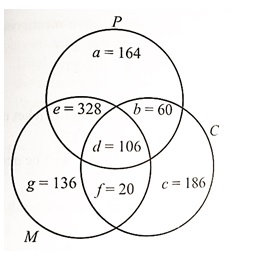
The result of an exam is given below. Out of 1000 students who appeared
(i) 658 failed in Physics
(ii) 166 failed in Physics and Chemistry
(iii) 372 failed in Chemistry, 434 failed in Physics and Maths
(iv) 590 failed in Maths, 126 failed in Maths & Chemistry
Find the number of people who failed in (assuming that none is passed in all subjects.
We have the following equations:
a+ b + c + d + e + f + g = 1000
a + b + d + e = 658, b + d = 166
b + d + c + f = 372
d + e = 434 as in the figure.
d + e + f + g = 590, d + f = 126. Find the values
Chemistry but not in Physics.
A
318
B
198
C
213
D
206
Question 184Single Answer
Passage :
Direction: information given below and answer the question that follow.
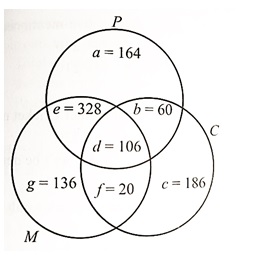
The result of an exam is given below. Out of 1000 students who appeared
(i) 658 failed in Physics
(ii) 166 failed in Physics and Chemistry
(iii) 372 failed in Chemistry, 434 failed in Physics and Maths
(iv) 590 failed in Maths, 126 failed in Maths & Chemistry
Find the number of people who failed in (assuming that none is passed in all subjects.
We have the following equations:
a+ b + c + d + e + f + g = 1000
a + b + d + e = 658, b + d = 166
b + d + c + f = 372
d + e = 434 as in the figure.
d + e + f + g = 590, d + f = 126. Find the values
Physics or Maths but not in Chemistry.
A
558
B
718
C
628
D
None of these
Question 185Single Answer
Passage :
For the next four question that follow:
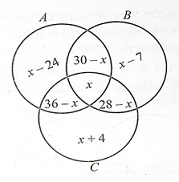
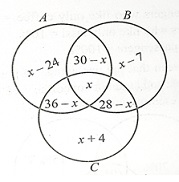
In a city, three daily newspapers A, B, C are published, 42% read A; 51% read B; 68% read C; 30% read A and B; 28% read B and C; 36% read A and C; 8% do not read any of the three newspapers.
Let x% people read all the three newspapers.
Since 8% people do not read any newspapers.
(x – 24) + (x – 7) + (x + 4) + (30 – x) + (36 – x) + (28 – x) + x = 92
→ x + 98 – 31 = 92
→ x = 92 – 67 = 25
What is the percentage of persons who read all the three papers ?
A
20%
B
25%
C
30%
D
40%
Question 186Single Answer
Passage :
For the next four : question that follow :
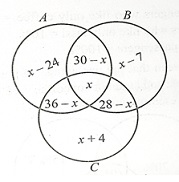
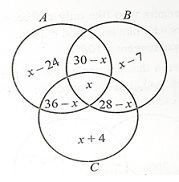
In a city, three daily newspapers A, B, C are published, 42% read A; 51% read B; 68% read C; 30% read A and B; 28% read B and C; 36% read A and C; 8% do not read any of the three newspapers.
Let x% people read all the three newspapers.
Since 8% people do not read any newspapers.
(x – 24) + (x – 7) + (x + 4) + (30 – x) + (36 – x) + (28 – x) + x = 92
→ x + 98 – 31 = 92
→ x = 92 – 67 = 25
What is the percentage of persons who read only two papers?
A
19%
B
31%
C
44%
D
None of these
Question 187Single Answer
Passage :
For the next four : question that follow :
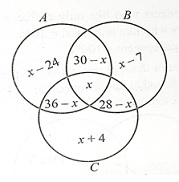
In a city, three daily newspapers A, B, C are published, 42% read A; 51% read B; 68% read C; 30% read A and B; 28% read B and C; 36% read A and C; 8% do not read any of the three newspapers.
Let x% people read all the three newspapers.
Since 8% people do not read any newspapers.
(x – 24) + (x – 7) + (x + 4) + (30 – x) + (36 – x) + (28 – x) + x = 92
→ x + 98 – 31 = 92
→ x = 92 – 67 = 25
What is the percentage of persons who read only one paper ?
A
38%
B
48%
C
51%
D
None of these
Question 188Single Answer
Passage :
For the next four : question that follow:
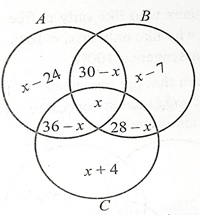
In a city, three daily newspapers A, B, C are published, 42% read A; 51% read B; 68% read C; 30% read A and B; 28% read B and C; 36% read A and C; 8% do not read any of the three newspapers.
Let x% people read all the three newspapers.
Since 8% people do not read any newspapers.
(x – 24) + (x – 7) + (x + 4) + (30 – x) + (36 – x) + (28 – x) + x = 92
→ x + 98 – 31 = 92
→ x = 92 – 67 = 25
What is the percentage of persons who read only A but neither B nor C ?
A
4%
B
3%
C
1%
D
None of these
Question 189Single Answer
Passage :
For the next four : question that follow:
In a city, three daily newspapers A, B, C are published, 42% read A; 51% read B; 68% read C; 30% read A and B; 28% read B and C; 36% read A and C; 8% do not read any of the three newspapers.
Let x% people read all the three newspapers.
Since 8% people do not read any newspapers.
(x – 24) + (x – 7) + (x + 4) + (30 – x) + (36 – x) + (28 – x) + x = 92
→ x + 98 – 31 = 92
→ x = 92 – 67 = 25
If A and B are any two sets, then what is A ᴖ (A ᴗ B) equal to ?
A
Complement of A
B
Complement of B
C
B
D
A
Question 190Single Answer
Passage :
For the next four : question that follow:
In a city, three daily newspapers A, B, C are published, 42% read A; 51% read B; 68% read C; 30% read A and B; 28% read B and C; 36% read A and C; 8% do not read any of the three newspapers.
Let x% people read all the three newspapers.
Since 8% people do not read any newspapers.
(x – 24) + (x – 7) + (x + 4) + (30 – x) + (36 – x) + (28 – x) + x = 92
→ x + 98 – 31 = 92
→ x = 92 – 67 = 25
40% of the people read newspaper X, 50% read newspaper Y and 10% read both the papers. What percentage of the people read neither newspaper ?
A
10%
B
15%
C
20%
D
25%
Reasoning
Question 191Single Answer
How many such pairs of letters are there in the word ‘CLEANLINESS’ each of the which has as many letters between them in the word as they have in the English alphabet, in the same sequence?
A
Two
B
Three
C
Five
D
Four
E
None of these
Question 192Single Answer
Team A has scored more goals than Team B
Team C has scored fewer goals than Team B
Team A has scored fewer goals than Team C .
If the first two statements are true, the third statement is
A
True
B
False
C
Uncertain
D
None
Question 193Single Answer
If it is possible to make only one meaningful word with the second, the third, the sixth and the eight letters of the word FRAGMENT using each only once, which of the following will be the third letter of that word ? If no such word can be formed, give ‘X’ as the answer and if more than one such word can be formed, give ‘Y’ as the answer.
A
A
B
E
C
T
D
X
E
Y
Question 194Single Answer
How many such letters are there in the word ORIENTAL each of which is as far away from the beginning of the word as when they are arranged alphabetically?
A
None
B
One
C
Two
D
Three
E
More than three
Question 195Single Answer
How many such pairs of letters in the word CREDIT each of which has as many letters between them in the word as in the English alphabet?
A
None
B
One
C
Two
D
Three
E
More than three
Question 196Single Answer
Passage :
A B C D E F G H I J K L M N O P Q R S T U V W X Y Z .
Which letter in this alphabet is the eighth letter to the right of the letter and which is tenth letter to the left of the last but one letter of the alphabet ?
A
X
B
W
C
I
D
H
Question 197Single Answer
Passage :
Direction : The following question is based on the five words given below:
AND FOR THE BIG SUM (The new words formed after performing the mentioned operations may or may not necessarily the meaningful English words.)
If the third alphabet of each of the words is changed to the next alphabet in the English alphabetical series, which of the following will form a meaningful English word?
A
SUM
B
BIG
C
Both BIG and THE
D
FOR
E
Both FOR and BIG
Question 198Single Answer
Passage :
Direction : The following question is based on the five words given below:
AND FOR THE BIG SUM (The new words formed after performing the mentioned operations may or may not necessarily the meaningful English words.)
If the given words are arranged in the order as they would appear in a dictionary from left to right, which of the following will be second from the right ?
A
AND
B
FOR
C
THE
D
BIG
E
SUM
Question 199Single Answer
Passage :
Direction: The following question is based on the five words given below:
AND FOR THE BIG SUM (The new words formed after performing the mentioned operations may or may not necessarily the meaningful English words.)
If second alphabet in each of the words is changed to next alphabet in the English alphabetical order, how many words having two vowels (same or different vowels) will be formed ?
A
None
B
One
C
Two
D
Three
E
Four
Question 200Single Answer
Passage :
Direction : The following question is based on the five words given below:
AND FOR THE BIG SUM (The new words formed after performing the mentioned operations may or may not necessarily the meaningful English words.)
How many letters are there in the English alphabetical series between the second letter of the word which is second from the right and the second letter of the word which is second from the left of the given words?