📚 Exam by Category
▾
Objective Questions

Latest OSSC CGL Assistant Embankment Inspector Exam Question (Objective Questions), MCQ in English

Subjects : Arithmatic-10th Standard, Data Interpretation, Logical Reasoning and Analytical Ability, General Mental Ability, Current Events of National and International Importance, Computer/ Internet Awareness, Odisha Economy, Odisha History, Odisha Geography, Odisha Heritage and Culture

Question Bank OSSC CGL (Assistant Embankment Inspector) Prelims Exam - English
Back to Exam

Arithmatic-10th Standard

Question 1Single Answer
The cash difference between the selling prices of an article at a profit of 4% and 6% is Rs. 3. The ratio of the two selling prices is:__________ ?
  1. A
    51:52
  2. B
    52:53
  3. C
    51:53
  4. D
    52:55
Question 2Single Answer
Which of the following numbers is irrational ?
  1. A
    √49
  2. B
    0.125
  3. C
    √2
  4. D
    22/7
Question 3Single Answer
356 x 936 – 356 x 836 = ?
  1. A
    35600  
  2. B
    34500
  3. C
    9630
  4. D
    93600
Question 4Single Answer
Arrange in descending order: 5/8, 7/10, 3/4
  1. A
    3/4 > 7/10 > 5/8
  2. B
    7/10 > 3/4 > 5/8
  3. C
    3/4 > 5/8 > 7/10
  4. D
    5/8 > 7/10 > 3/4
Question 5Single Answer
What is (3^{4} times 9^{2}) ?
  1. A
    36
  2. B
    38
  3. C
    310
  4. D
    96
     
Question 6Single Answer
If 34X-2 = 729, then find the value of X.
  1. A
    4     
  2. B
    3
  3. C
    2 
  4. D
    5
Question 7Single Answer
Convert 0.6 into fraction ?
  1. A
    3/5
  2. B
    2/3
  3. C
    4/5
Question 8Single Answer
The no. plate of a bus had peculiarity. The bus number was a perfect square. It was also a perfect square when the plate numbers were reversed. The bus company had only five hundred buses numbered from 1 to 500. What was the number ?
  1. A
    169  
  2. B
    36
  3. C
    196 
  4. D
    Can not say
Question 9Single Answer
If a and b are positive integers, such that ab = 125, then (a-b)a+b-4 = ?
  1. A
    16   
  2. B
    25
  3. C
    28  
  4. D
    30
Question 10Single Answer
If x*y = x2 + y2 – xy, then value of 9*11 is
  1. A
    93     
  2. B
    103
  3. C
    60.5
  4. D
    121
Question 11Single Answer
Which is greater ?
  1. A
    15/16
  2. B
    17/18
  3. C
    Equal
  4. D
    Cannot compare
Question 12Single Answer
If sum of two numbers is 42 and their product is 437, then find their difference.
  1. A
    3 
  2. B
    4
  3. C
    5    
  4. D
    7
Question 13Single Answer
Write the 44000 in Roman numerals
  1. A
    XLI 
  2. B
    XLVI
  3. C
    XLIV 
  4. D
    XLVIC
Question 14Single Answer
Convert 0.0909… into fraction ?
  1. A
    1/11
  2. B
    9/11
  3. C
    1/9
  4. D
    9/10
Question 15Single Answer
What is (98 times 102) ?
  1. A
    9996
  2. B
    10000
  3. C
    10096
  4. D
    10196
Question 16Single Answer
Passage :
information given below and answer the question that follow.
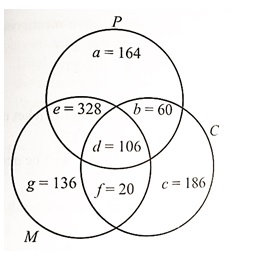
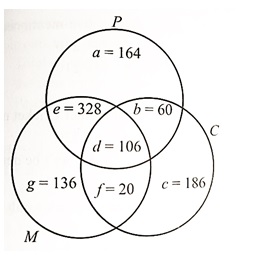
The result of an exam is given below. Out of 1000 students who appeared
(i) 658 failed in Physics
(ii) 166 failed in Physics and Chemistry
(iii) 372 failed in Chemistry, 434 failed in Physics and Maths
(iv) 590 failed in Maths, 126 failed in Maths & Chemistry
Find the number of people who failed in (assuming that none is passed in all subjects.

We have the following equations:
a+ b + c + d + e + f + g = 1000
a + b + d + e = 658, b + d = 166
b + d + c + f = 372
d + e = 434 as in the figure.
d + e + f + g = 590, d + f = 126. Find the values
Chemistry but not in Physics.
  1. A
    318
  2. B
    198
  3. C
    213 
  4. D
    206
Question 17Single Answer
Passage :
Direction: information given below and answer the question that follow.
The result of an exam is given below. Out of 1000 students who appeared
(i) 658 failed in Physics
(ii) 166 failed in Physics and Chemistry
(iii) 372 failed in Chemistry, 434 failed in Physics and Maths
(iv) 590 failed in Maths, 126 failed in Maths & Chemistry
Find the number of people who failed in (assuming that none is passed in all subjects.

We have the following equations:
a+ b + c + d + e + f + g = 1000
a + b + d + e = 658, b + d = 166
b + d + c + f = 372
d + e = 434 as in the figure.
d + e + f + g = 590, d + f = 126. Find the values
Physics or Maths but not in Chemistry.
  1. A
    558   
  2. B
    718
  3. C
    628  
  4. D
    None of these
Question 18Single Answer
Passage :
For the next four question that follow:
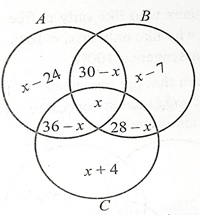
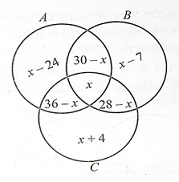
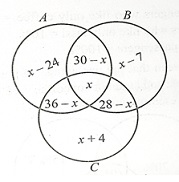
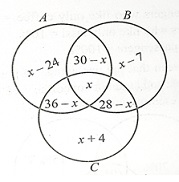
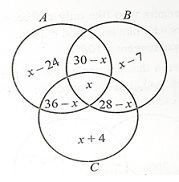
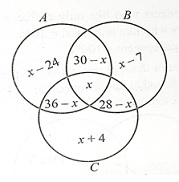
In a city, three daily newspapers A, B, C are published, 42% read A; 51% read B; 68% read C; 30% read A and B; 28% read B and C; 36% read A and C; 8% do not read any of the three newspapers.

Let x% people read all the three newspapers.
Since 8% people do not read any newspapers.
 (x – 24) + (x – 7) + (x + 4) + (30 – x) + (36 – x) + (28 – x) + x = 92
→ x + 98 – 31 = 92
→ x = 92 – 67 = 25
What is the percentage of persons who read all the three papers ?
  1. A
    20%  
  2. B
    25%
  3. C
    30%  
  4. D
    40%
Question 19Single Answer
Passage :
For the next four : question that follow :
In a city, three daily newspapers A, B, C are published, 42% read A; 51% read B; 68% read C; 30% read A and B; 28% read B and C; 36% read A and C; 8% do not read any of the three newspapers.

Let x% people read all the three newspapers.
Since 8% people do not read any newspapers.
 (x – 24) + (x – 7) + (x + 4) + (30 – x) + (36 – x) + (28 – x) + x = 92
→ x + 98 – 31 = 92
→ x = 92 – 67 = 25
What is the percentage of persons who read only two papers?
  1. A
    19%  
  2. B
    31%
  3. C
    44%
  4. D
    None of these
Question 20Single Answer
Passage :
For the next four : question that follow :
In a city, three daily newspapers A, B, C are published, 42% read A; 51% read B; 68% read C; 30% read A and B; 28% read B and C; 36% read A and C; 8% do not read any of the three newspapers.

Let x% people read all the three newspapers.
Since 8% people do not read any newspapers.
(x – 24) + (x – 7) + (x + 4) + (30 – x) + (36 – x) + (28 – x) + x = 92
→ x + 98 – 31 = 92
→ x = 92 – 67 = 25
What is the percentage of persons who read only one paper ?
  1. A
    38% 
  2. B
    48%
  3. C
    51%  
  4. D
    None of these
Question 21Single Answer
Passage :
For the next four : question that follow:
In a city, three daily newspapers A, B, C are published, 42% read A; 51% read B; 68% read C; 30% read A and B; 28% read B and C; 36% read A and C; 8% do not read any of the three newspapers.

Let x% people read all the three newspapers.
Since 8% people do not read any newspapers.
 (x – 24) + (x – 7) + (x + 4) + (30 – x) + (36 – x) + (28 – x) + x = 92
→ x + 98 – 31 = 92
→ x = 92 – 67 = 25
What is the percentage of persons who read only A but neither B nor C ?
  1. A
    4%
  2. B
    3%
  3. C
    1%  
  4. D
    None of these
Question 22Single Answer
Passage :
For the next four : question that follow:
In a city, three daily newspapers A, B, C are published, 42% read A; 51% read B; 68% read C; 30% read A and B; 28% read B and C; 36% read A and C; 8% do not read any of the three newspapers.

Let x% people read all the three newspapers.
Since 8% people do not read any newspapers.
 (x – 24) + (x – 7) + (x + 4) + (30 – x) + (36 – x) + (28 – x) + x = 92
→ x + 98 – 31 = 92
→ x = 92 – 67 = 25
If A and B are any two sets, then what is A ᴖ (A ᴗ B) equal to ?
  1. A
    Complement of A 
  2. B
    Complement of B
  3. C
    B   
  4. D
    A
Question 23Single Answer
Passage :
For the next four : question that follow:
In a city, three daily newspapers A, B, C are published, 42% read A; 51% read B; 68% read C; 30% read A and B; 28% read B and C; 36% read A and C; 8% do not read any of the three newspapers.

Let x% people read all the three newspapers.
Since 8% people do not read any newspapers.
 (x – 24) + (x – 7) + (x + 4) + (30 – x) + (36 – x) + (28 – x) + x = 92
→ x + 98 – 31 = 92
→ x = 92 – 67 = 25
40% of the people read newspaper X, 50% read newspaper Y and 10% read both the papers. What percentage of the people read neither newspaper ?
  1. A
    10%    
  2. B
    15%
  3. C
    20%  
  4. D
    25%
Question 24Single Answer
Passage :
Read the passage below and solve the question based on it.
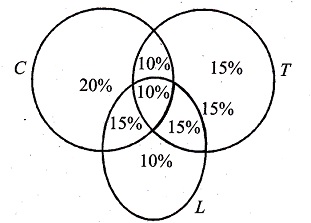
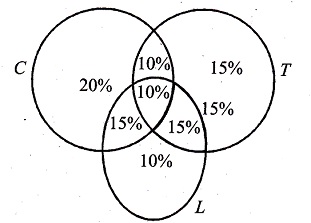
5% of the passengers do not like coffee, tea and lassi and 10% like all the three, 20% like coffee and tea, 25% like lassi and coffee and 25% like lassi and tea. 55% like coffee, 50% like tea, and 50% like lassi.

Where C = Coffee, T = Tea and L =Lassi
The passengers who like only coffee is greater than the passengers who like only lassi by
  1. A
    25%   
  2. B
    100%
  3. C
    75%   
  4. D
    0%
Question 25Single Answer
Passage :
Read the passage below and solve the question based on it.
5% of the passengers do not like coffee, tea and lassi and 10% like all the three, 20% like coffee and tea, 25% like lassi and coffee and 25% like lassi and tea. 55% like coffee, 50% like tea, and 50% like lassi.

Where C = Coffee, T = Tea and L =Lassi
The percentage of passengers who like both tea and lassi but not coffee, is
  1. A
    15 
  2. B
    25
  3. C
    40 
  4. D
    75

Data Interpretation

Question 26Single Answer
Passage :
Direction : Each of the questions below consists of a question and two statements numbered (I) and (II) given below it. You have to decide whether the data provided in the statements are sufficient to answer the question. Read both the statements and give answer  :
How many employees of bank ‘X’ opted for VRS ?
(I) 18% of the 950 officer cadre employees and 6% of the 1100 of all other cadre employees opted for VRS.
(II) 28% of the employees in the age group of 51 to 56 and 17% of the employees in all other age groups opted for VRS.
  1. A
    Statement (I) ALONE is sufficient, but statement (II) alone is not sufficient
  2. B
    Statement (II) ALONE is sufficient, but statement (I) alone is not sufficient
  3. C
    BOTH statements TOGETHER are sufficient, but NEITHER statement alone is sufficient
  4. D
    EACH statement ALONE is sufficient
Question 27Single Answer
Passage :
Direction : Each of the questions below consists of a question and two statements numbered (I) and (II) given below it. You have to decide whether the data provided in the statements are sufficient to answer the question. Read both the statements and give answer  :
The area of a playground is 1600 square meters. What is its perimeter ?
(I) It is a perfect square playground
(II) It costs Rs.3200 to put a fence around the playground at the rate of Rs.20 per meter.
  1. A
    Statement (I) ALONE is sufficient, but statement (II) alone is not sufficient
  2. B
    Statement (II) ALONE is sufficient, but statement (I) alone is not sufficient
  3. C
    BOTH statements TOGETHER are sufficient, but NEITHER statement alone is sufficient
  4. D
    EACH statement ALONE is sufficient
Question 28Single Answer
Passage :
Direction : Each of the questions below consists of a question and two statements numbered (I) and (II) given below it. You have to decide whether the data provided in the statements are sufficient to answer the question. Read both the statements and give answer  :
What is the value of m – n ÷ 37 ?
(I) m is the largest possible six-digit number and n is the smallest possible six-digit number.
(II) The difference between m and n is known.
  1. A
    Statement (I) ALONE is sufficient, but statement (II) alone is not sufficient
  2. B
    Statement (II) ALONE is sufficient, but statement (I) alone is not sufficient
  3. C
    BOTH statements TOGETHER are sufficient, but NEITHER statement alone is sufficient
  4. D
    EACH statement ALONE is sufficient
Question 29Single Answer
Passage :
Direction : Each of the questions below consists of a question and two statements numbered (I) and (II) given below it. You have to decide whether the data provided in the statements are sufficient to answer the question. Read both the statements and give answer  :
What is the value of x  ?
(I) If 10 is added to x, the result is 34.
(II) If x is multiplied by y, the result is 38.
  1. A
    Statement (I) ALONE is sufficient, but statement (II) alone is not sufficient
  2. B
    Statement (II) ALONE is sufficient, but statement (I) alone is not sufficient
  3. C
    BOTH statements TOGETHER are sufficient, but NEITHER statement alone is sufficient
  4. D
    EACH statement ALONE is sufficient
Question 30Single Answer
Passage :
Direction : Each of the questions below consists of a question and two statements numbered (I) and (II) given below it. You have to decide whether the data provided in the statements are sufficient to answer the question. Read both the statements and give answer  :
What was the total compound interest on a sum after three years  ?
(I) The interest after one year was Rs. 100 and the sum after was Rs.1000.
(II) The difference between simple and compound interest on a sum of Rs.1000 at the end of two years was Rs.10.
  1. A
    Statement (I) ALONE is sufficient, but statement (II) alone is not sufficient
  2. B
    Statement (II) ALONE is sufficient, but statement (I) alone is not sufficient
  3. C
    BOTH statements TOGETHER are sufficient, but NEITHER statement alone is sufficient
  4. D
    EACH statement ALONE is sufficient
Question 31Single Answer
Passage :
Each of the questions below consists of a question and two statements numbered (1) and (2) given below it. You have to decide whether the data provided in the statements are sufficient to answer the question. Read both the statements and give answer.
Among Japanese Yen, Australian Dollar, Hong Kong Dollar and Singapore Dollar, which currency has the lowest value in terms of Indian rupees ?
(1) One rupee is equal to 2.56 Japanese Yen, 0.338 Australian Dollar, and 0.465 Hong Kong Dollar.
(2) Value of Australian Dollar is equal to Singapore Dollar.
  1. A
    Statement (1) ALONE is sufficient, but statement (2) alone is not sufficient
  2. B
    Statement (2) ALONE is sufficient, but statement (I) alone is not sufficient
  3. C
    BOTH statements TOGETHER are sufficient, but NEITHER statement alone is sufficient
  4. D
    Statements (1) and (2) TOGETHER are NOT sufficient
Question 32Single Answer
Passage :
Each of the questions below consists of a question and two statements numbered (1) and (2) given below it. You have to decide whether the data provided in the statements are sufficient to answer the question. Read both the statements and give answer.
What is the value of a two-digit number ? 
(1) The sum of the two digits is 4.
(2) The difference between the two digits is 2.
  1. A
    Statement (1) ALONE is sufficient, but statement (2) alone is not sufficient
  2. B
    Statement (2) ALONE is sufficient, but statement (I) alone is not sufficient
  3. C
    BOTH statements TOGETHER are sufficient, but NEITHER statement alone is sufficient
  4. D
    Statements (1) and (2) TOGETHER are NOT sufficient
Question 33Single Answer
Passage :
Each of the questions below consists of a question and two statements numbered (1) and (2) given below it. You have to decide whether the data provided in the statements are sufficient to answer the question. Read both the statements and give answer.
What was the population of State ‘A’ in 1999 ?
(1) Population of the State increases every year by 20% and its population in 1997 was 1,20,000.
(2) Population of State A in 1997 was twice that of State B in the same year.
  1. A
    Statement (1) ALONE is sufficient, but statement (2) alone is not sufficient
  2. B
    Statement (2) ALONE is sufficient, but statement (I) alone is not sufficient
  3. C
    BOTH statements TOGETHER are sufficient, but NEITHER statement alone is sufficient
  4. D
    Statements (1) and (2) TOGETHER are NOT sufficient
Question 34Single Answer
Passage :
Each of the questions below consists of a question and two statements numbered (1) and (2) given below it. You have to decide whether the data provided in the statements are sufficient to answer the question. Read both the statements and give answer.
What is the speed of the boat in still water ?
(1) It takes 2 hours to cover the distance between A and B downstream.
(2) It takes 4 hours to cover the distance between A and B upstream.
  1. A
    Statement (1) ALONE is sufficient, but statement (2) alone is not sufficient
  2. B
    Statement (2) ALONE is sufficient, but statement (I) alone is not sufficient
  3. C
    BOTH statements TOGETHER are sufficient, but NEITHER statement alone is sufficient
  4. D
    Statements (1) and (2) TOGETHER are NOT sufficient
Question 35Single Answer
Passage :
Each of the questions below consists of a question and two statements numbered (1) and (2) given below it. You have to decide whether the data provided in the statements are sufficient to answer the question. Read both the statements and give answer.
How many vinyl squares with sides 5 inches long will be needed to cover the rectangular floor of a room ?
(1) The floor is 5ft long.                 
(2) The floor is 3 ft wide.
  1. A
    Statement (1) ALONE is sufficient, but statement (2) alone is not sufficient
  2. B
    Statement (2) ALONE is sufficient, but statement (I) alone is not sufficient
  3. C
    BOTH statements TOGETHER are sufficient, but NEITHER statement alone is sufficient
  4. D
    Statements (1) and (2) TOGETHER are NOT sufficient
Question 36Single Answer
Passage :
Direction : in the following question two statements (Quantity – I and Quantity – II) are given .You have to solve both the statements and give answer.
Quantity I: On selling 17 balls at Rs720, there is a loss equal to the cost price of 5 balls. The cost price of a ball is :
Quantity II: A man buys a cycle for Rs 1400 and sells it at a loss of 15%. The selling price is :
  1. A
    Quantity I > Quantity II
  2. B
    Quantity I Quantity II
  3. C
    Quantity II Quantity I
  4. D
    Quantity I = Quantity II or Relation cannot be established
Question 37Single Answer
Passage :
Direction : in the following question two statements (Quantity – I and Quantity – II) are given .You have to solve both the statements and give answer.
Quantity I : A and B together can do a piece of work in 4 days. If A alone can do the same work in 6 days, then B alone can do the same work in ?
Quantity II : A can do a piece of work in 4 hours; B and C together can do it in 3 hours, while A and C together can do it in 2 hours. How long will B alone take to do it ?
  1. A
    Quantity I > Quantity II
  2. B
    Quantity I  Quantity II
  3. C
    Quantity II Quantity I
  4. D
    Quantity I = Quantity II or Relation cannot be established
Question 38Single Answer
Passage :
Direction : in the following question two statements (Quantity – I and Quantity – II) are given .You have to solve both the statements and give answer.
Quantity I : ‘x’ : Train ‘A’ running at a speed of 25 m/sec crosses Train ‘Z’ coming from opposite direction running at a speed of 15 m/sec in 12 seonds. Length of Train ‘A’ is twice of train ‘B’. Length of train ‘A’ is ‘x’
Quantity II : 160 meters.
(a) Quantity I > Quantity II             (b) Quantity I < Quantity II
(c) Quantity I ≥ Quantity II             (d) Quantity I ≤ Quantity II
(e) Quantity I = Quantity II or No Relation
  1. A
    Quantity I > Quantity II
  2. B
    Quantity I ≥ Quantity II
  3. C
    Quantity II > Quantity I
  4. D
    Quantity I = Quantity II or Relation cannot be established
Question 39Single Answer
Passage :
Direction : in the following question two statements (Quantity – I and Quantity – II) are given .You have to solve both the statements and give answer.
Quantity I : ‘x’ : A pipe alone can fill a cistern in 60 minutes. But due to leakage pipe filled only 80% of the cistern in 1 hour. ‘x’ is the capacity of cistern in liters if due to leakage 60 liter can be leaked out in 1 hour.
Quantity II : 250 liters
(a) Quantity I > Quantity II            (b) Quantity I < Quantity II
(c) Quantity I ≥ Quantity II            (d) Quantity I ≤ Quantity II
(e) Quantity I = Quantity II or No Relation 
  1. A
    Quantity I > Quantity II
  2. B
    Quantity I ≥ Quantity II
  3. C
    Quantity II > Quantity I
  4. D
    Quantity I = Quantity II or Relation cannot be established
Question 40Single Answer
Passage :
Direction : Each of the question below consist of a question and two statements numbered (1) and (2) given below it.you have to decide whether the data provided in the statements are sufficient to answer the question. Read both the statement and give answer.
Average weight of four persons is 67 kg.These persons are A, B, C and D. When E is included in the group, average weight decreases by 2 kg. What is the weight of A? A’s weight is 4 kg more than B’s weight.
(I) When B is displaced by another person F, whose weight is 4 kg more than E, average weight becomes 64 kg.
(II) When D is displaced by another person G, whose weight is 4 kg more than E, average weight becomes 65 kg.
  1. A
    Statement(I) ALONE is sufficient , but statement (II) alone is not sufficient
  2. B
    Statement (II) ALONE is sufficient , but statement (I) alone is not sufficient
  3. C
    BOTH Statement TOGETHER are sufficient , but NEITHER statement alone is sufficient
  4. D
    EACH statement ALONE is sufficient
Question 41Single Answer
Passage :
Direction : Each of the question below consist of a question and two statements numbered (1) and (2) given below it.you have to decide whether the data provided in the statements are sufficient to answer the question. Read both the statement and give answer.
Is x an integer ?
  1. A
    Statement (I) ALONE is sufficient , but statement (II) alone is not sufficient
  2. B
    Statement (II) ALONE is sufficient , but statement (I) alone is not sufficient
  3. C
    BOTH Statement TOGETHER are sufficient , but NEITHER statement alone is sufficient
  4. D
    EACH statement ALONE is sufficient
Question 42Single Answer
Passage :
Direction : Each of the question below consist of a question and two statements numbered (1) and (2) given below it.you have to decide whether the data provided in the statements are sufficient to answer the question. Read both the statement and give answer.
Out of the four teams A, B, C and D which team is not likely to win as per the opinion poll ?
(I) As per the opinion poll, chances of team C’s winning are more than that of team A.
(II) As per the opinion poll team C’s chances of winning are less than that of team B but not less than that of team D, whose chances of winning are more than that of team A.
  1. A
    Statement (I) ALONE is sufficient , but statement (II) alone is not sufficient
  2. B
    Statement (II) ALONE is sufficient , but statement (I) alone is not sufficient
  3. C
    BOTH Statement TOGETHER are sufficient , but NEITHER statement alone is sufficient
  4. D
    EACH statement ALONE is sufficient
Question 43Single Answer
Passage :
Direction : Each of the question below consist of a question and two statements numbered (1) and (2) given below it.you have to decide whether the data provided in the statements are sufficient to answer the question. Read both the statement and give answer.
A, B and C are positive integers. Is their product an even number ?
(I) A is an even number.
(II) The product of A and B is an even number and that of A and C is also an even number.
  1. A
    Statement (I) ALONE is sufficient , but statement (II) alone is not sufficient
  2. B
    Statement (II) ALONE is sufficient , but statement (I) alone is not sufficient
  3. C
    BOTH Statement TOGETHER are sufficient , but NEITHER statement alone is sufficient
  4. D
    EACH statement ALONE is sufficient
Question 44Single Answer
Passage :
Direction : Each of the question below consist of a question and two statements numbered (1) and (2) given below it.you have to decide whether the data provided in the statements are sufficient to answer the question. Read both the statement and give answer.
What was Mr. Srinivasula’s combined income for the year 1994-1999 ? In 1994, he made Rs.10,00,000.
(I) His average yearly income for the years 1994-1999 was Rs.12,00,000.
(II) In 1999, his income was Rs.20,00,000.
  1. A
    Statement (I) ALONE is sufficient , but statement (II) alone is not sufficient
  2. B
    Statement (II) ALONE is sufficient , but statement(I) alone is not sufficient
  3. C
    BOTH Statement TOGETHER are sufficient , but NEITHER statement alone is sufficient
  4. D
    EACH statement ALONE is sufficient
Question 45Single Answer
Passage :
Direction : Each of the question below consist of a question and two statements numbered (1) and (2) given below  it .you have to decide whether the data provided in the statements are sufficient to answer the question . Statement (1) ALONE is sufficient , but statement (2) alone is not sufficient
A, B, C and D made their project presentation, one on each day, on four consecutive days but not necessarily in that order. On which day did ‘C’ make his presentation ?
(1) The first presentation was made on 23rd, Tuesday and was followed by ‘D’s presentation.
(2) ‘A’ did not make his presentation on 25th and one of them made his presentation, between A’s and B’s.
  1. A
    Statement (2) ALONE is sufficient , but statement (1) alone is not sufficient
  2. B
    statement (1) and (2) TOGETHER are NOT sufficient
  3. C
    BOTH Statement TOGETHER are sufficient , but NEITHER statement alone is sufficient
  4. D
    Statement (1) and (2) TOGETHER are NOT sufficient
Question 46Single Answer
Passage :
Direction : Each of the question below consist of a question and two statements numbered (1) and (2) given below  it .you have to decide whether the data provided in the statements are sufficient to answer the question . Statement (1) ALONE is sufficient , but statement (2) alone is not sufficient
How many houses on the street are painted blue ?
(1) Houses on the east side with number 122 through 182 are painted blue.
(2) Houses on the west and east sides have consecutive odd and even number respectively.
  1. A
    Statement (2) ALONE is sufficient , but statement (1) alone is not sufficient
  2. B
    Statement (1) and (2) TOGETHER are NOT sufficient
  3. C
    BOTH Statement TOGETHER are sufficient , but NEITHER statement alone is sufficient
  4. D
    Statement (1) and (2) TOGETHER are NOT sufficient
Question 47Single Answer
Passage :
Direction : Each of the question below consist of a question and two statements numbered (1) and (2) given below  it .you have to decide whether the data provided in the statements are sufficient to answer the question . Statement (1) ALONE is sufficient , but statement (2) alone is not sufficient
Is Mr. ‘Y’ entitled to get promotion in the month of September 2002 ?
(1) As per his office rules, the only condition for promotion is completion of 12 years of service in a particular grade on 31st December of every year.
(2) Mr. ‘Y’ has been working in this office for the last 12 years.
  1. A
    Statement (2) ALONE is sufficient , but statement (1) alone is not sufficient
  2. B
    Statement (1) and (2) TOGETHER are NOT sufficient
  3. C
    BOTH Statement TOGETHER are sufficient , but NEITHER statement alone is sufficient
  4. D
    Statement (1) and (2) TOGETHER are NOT sufficient
Question 48Single Answer
Passage :
Direction : Each of the question below consist of a question and two statements numbered (1) and (2) given below  it .you have to decide whether the data provided in the statements are sufficient to answer the question . Statement (1) ALONE is sufficient , but statement (2) alone is not sufficient
What is the distance Between D1 and D2 ? It is given that a man who can row x km/hr in still water, takes z hrs to row from D1 to D2 and back to D1, in a stream which flows at y km/hr.
(1) Value of (x2- y2) is known.
(2) (x ÷ z) is known.
  1. A
    Statement (2) ALONE is sufficient , but statement (1) alone is not sufficient
  2. B
    Statement (1) and (2) TOGETHER are NOT sufficient
  3. C
    BOTH Statement TOGETHER are sufficient , but NEITHER statement alone is sufficient
  4. D
    Statement (1) and (2) TOGETHER are NOT sufficient
Question 49Single Answer
Passage :
Direction : Each of the question below consist of a question and two statements numbered (1) and (2) given below  it .you have to decide whether the data provided in the statements are sufficient to answer the question . Statement (1) ALONE is sufficient , but statement (2) alone is not sufficient
Is ababab divisible by 222 where a and b are two digits ?
(1) a + b = 5.         (2) b is an even number
  1. A
    Statement (2) ALONE is sufficient , but statement (1) alone is not sufficient
  2. B
    Statement (1) and (2) TOGETHER are NOT sufficient
  3. C
    BOTH Statement TOGETHER are sufficient , but NEITHER statement alone is sufficient
  4. D
    Statement (1) and (2) TOGETHER are NOT sufficient
Question 50Single Answer
Passage :
Direction : Each of the question below consist of a question and two statements numbered (1) and (2) given below  it .you have to decide whether the data provided in the statements are sufficient to answer the question . Statement (1) ALONE is sufficient , but statement (2) alone is not sufficient
Is (X2 + Y2 + Z2) even? [X, Y, Z are integers]
(1) X, Y, Z are consecutive.     (2) X2 + Z2 is even.
  1. A
    Statement (2) ALONE is sufficient , but statement (1) alone is not sufficient
  2. B
    Statement (1) and (2) TOGETHER are NOT sufficient
  3. C
    BOTH Statement TOGETHER are sufficient , but NEITHER statement alone is sufficient
  4. D
    Statement (1) and (2) TOGETHER are NOT sufficient
Important Questions Package

OSSC CGL Assistant Embankment Inspector Exam Online Question Bank Package

Buy OSSC CGL Assistant Embankment Inspector Important Questions, MCQ, question answer in Hindi & English. It will help you to score high marks in OSSC CGL Assistant Embankment Inspector question bank 2026 in Online, PDF & Print study material.

+ Free Monthly Current Affairs, GK & more PDF Download
Sr.Package NameAmount
1.OSSC CGL (Assistant Embankment Inspector) Prelims Exam - English
Description : 1000 Question with Answer
₹101 [₹500]
2.OSSC CGL (Assistant Embankment Inspector) Prelims Exam - English
Description : 2000 Question with Answer
₹141 [₹500]
3.OSSC CGL (Assistant Embankment Inspector) Prelims Exam - English
Description : 3000 Question with Answer
₹171 [₹500]
4.OSSC CGL (Assistant Embankment Inspector) Prelims Exam - English
Description : 4000 Question with Answer
₹201 [₹500]
5.OSSC CGL (Assistant Embankment Inspector) Mains Exam - English
Description : 1000 Question with Answer
₹101 [₹500]
6.OSSC CGL (Assistant Embankment Inspector) Mains Exam - English
Description : 2000 Question with Answer
₹141 [₹500]
7.OSSC CGL (Assistant Embankment Inspector) Mains Exam - English
Description : 3000 Question with Answer
₹171 [₹500]
8.OSSC CGL (Assistant Embankment Inspector) Prelims Exam - English
Description : 1000 Question & Answer Download in PDF (Send by Email)
₹151 [₹450]
9.OSSC CGL (Assistant Embankment Inspector) Mains Exam - English
Description : 1000 Question & Answer Download in PDF (Send by Email)
₹151 [₹450]
10.OSSC CGL (Assistant Embankment Inspector) Prelims Exam Question Bank Book - English
Description : 1000 Question with Answer (Printed Material)
₹390 [₹600]
11.OSSC CGL (Assistant Embankment Inspector) Mains Exam Question Bank Book - English
Description : 1000 Question with Answer (Printed Material)
₹390 [₹600]
Back to Exam
Question for OSSC CGL (Assistant Embankment Inspector) 2026 - Quiz / Questions / MCQ - Toppersexam