To discover new facts or to make fresh interpretation of known facts
Question 2Single Answer
Sampling error decreases with the
A
decrease in sample size
B
increase in sample size
C
process of randomization
D
process of analysis
Question 3Single Answer
The principles of fundamental research are used in
A
action research
B
applied research
C
philosophical research
D
historical research
Question 4Single Answer
Users who use media for their own ends are indentified as
A
Passive audience
B
Active audience
C
Positive audience
D
Negative audience
Question 5Single Answer
Classroom communication can be described as
A
Exploration
B
Institutionalisation
C
Unsignified narration
D
Discourse
Question 6Single Answer
Ideological codes shape our collective
A
Productions
B
Perceptions
C
Consumptions
D
Creations
Question 7Single Answer
In communication, myths have power, but are
A
Uncultural.
B
Insignificant.
C
imprecise.
D
Unpreferred.
Question 8Single Answer
The first multi-lingual news agency of India was
A
Samachar
B
API
C
Hindustan Samachar
D
Samachar Bharati
Question 9Single Answer
Organisational communication can also be equated with
A
intra-personal communication
B
inter-personal communication
C
group communication
D
mass communication
Question 10Single Answer
If two propositions having the same subject and predicate terms are such that one is the denial of the other, the relationship between them is called
A
Contradictory
B
Contrary
C
Sub-contrary
D
Sub-alternation
Question 11Single Answer
Ananya and Krishna can speak and follow English. Bulbul can write and speak. Hindi as Archana does. Archana talks with Ananya also in Bengali. Krishna can not follow Bengali. Bulbul talks with Ananya in Hindi. Who can speak and follow English, Hindi and Bengali?
A
Archana
B
Bulbul
C
Ananya
D
Krishna
Question 12Single Answer
A stipulative definition may be said to be
A
Always true
B
Always false
C
Sometimes true, sometimes false
D
Neither true nor false
Question 13Single Answer
Which one of the following references is written as per Modern Language Association (MLA) format?
A
Hall, Donald. Fundamentals of Electronics, New Delhi : Prentice Hall of India, 2006
B
Hall, Donald, Fundamentals of Electronics, New Delhi : Prentice Hall of India, 2003
C
Hall, Donald. Fundamentals of Electronics, New Delhi : Prentice Hall of India, 2002
D
Hall, Donald. Fundamentals of Electronics. New Delhi : Prentice Hall of India, 2005
Question 14Single Answer
When the conclusion of an argument follows from its premise/premises conclusively, the argument is called
A
Circular argument
B
Inductive argument
C
Deductive argument
D
Analogical argument
Question 15Single Answer
A workshop is
A
a conference for discussion on a topic.
B
a meeting for discussion on a topic.
C
a class at a college or a university in which a teacher and the students discuss a topic.
D
a brief intensive course for a small group emphasizing the development of a skill or technique for solving a specific problem.
Question 16Single Answer
A working hypothesis is
A
a proven hypothesis for an argument.
B
not required to be tested.
C
a provisionally accepted hypothesis for further research.
D
a scientific theory.
Question 17Single Answer
Saturn and Mars are planets like the earth. They borrow light from the Sun and moves around the Sun as the Earth does. So those planets are inhabited by various orders of creatures as the earth is. What type of argument is contained in the above passage?
A
Deductive
B
Astrological
C
Analogical
D
Mathematical
Question 18Single Answer
Given below are two premises. Four conclusions are drawn from those two premises in four codes. Select the code that states the conclusion validly drawn.
All saints are religious. (major)
Some honest persons are saints.(minor)Codes:
A
Codes:
All saints are hones.
B
Some saints are honest.
C
Some honest persons are religious.
D
All religious persons are honest.
Question 19Single Answer
In the process of communication, which one of the following is in chronological order?
A
Communicator, Medium, Receiver, Effect, Message
B
Medium, Communicator, Message, Receiver, Effect
C
Communicator, Message, Medium, Receiver, Effect
D
Message, Communicator, Medium, Receiver, Effect
Question 20Single Answer
Bengal Gazette, the first Newspaper in India was started in 1780 by
A
Dr. Annie Besant
B
James Augustus Hicky
C
Lord Cripson
D
A.O. Hume
Question 21Single Answer
Press censorship in India was imposed during the tenure of the Prime Minister
A
Rajeev Gandhi
B
Narasimha Rao
C
Indira Gandhi
D
Deve Gowda
Question 22Single Answer
Communication via New media such as computers, teleshopping, internet and mobile telephony is termed as
A
Entertainment
B
Interactive communication
C
Developmental communication
D
Communitarian
Question 23Single Answer
Classroom communication of a teacher rests on the principle of
A
Infotainment
B
Edutainment
C
Entertainment
D
Enlightenment
Question 24Single Answer
Identify the region that has shown hyper growth rate of foreign tourist arrivals than the growth rate of the total FTAs in India in 2008.
A
Western Europe
B
North America
C
South Asia
D
East Asia
Question 25Single Answer
____ is important when a teacher communicates with his her student.
A
Sympathy
B
Empathy
C
Apathy
D
Antipathy
Question 26Single Answer
Passage :
Read the following passage carefully and answer the questions :
The Taj Mahal has become one of the world’s best known monuments. This domed white marble structure is situated on a high plinth at the southern end of a four-quartered garden, evoking the gardens of paradise, enclosed within walls measuring 305 by 549 metres. Outside the walls, in an area known as Mumtazabad, were living quarters for attendants, markets, serais and other structures built by local merchants and nobles. The tomb complex and the other imperial structures of Mumtazabad were maintained by the income of thirty villages given specifically for the tomb’s support. The name Taj Mahal is unknown in Mughal chronicles, but it is used by contemporary Europeans in India, suggesting that this was the tomb’s popular name. in contemporary texts, it is generally called simply the Illuminated Tomb (Rauza-i-Munavvara). Mumtazz Mahal died shortly after delivering her fourteenth child in 1631. The Mughal court was then residing in Burhanpur. Her remains were temporarily buried by the griefstricken emperor in a spacious garden known as Zainabad on the bank of the river Tapti. Six months later her body was transported to Agra, where it was interred in land chosen for the mausoleum. This land, situated south of the Mughal city on the bank of the Jamuna, had belonged to the Kachhwaha Rajas since the time of Raja Man Singh and was purchased from the current raja. Jai Singh. Although contemporary chronicles indicate Jai Singh’s willing cooperation in this exchange, extant farmans (imperial commands) indicate that the final price was not settled until almost two years after the mausoleum‘s commencement. Jai Singh’s further cooperation was insured by imperial orders issued between 1632 and 1637 demanding that he provide stone masons and carts to transport marble from the mines at Makrana, within his “ancestral domain’’, to Agra where both the Taj Mahal and ShajJahan’s additions to the Agra fort were concurrently. Work on the mausoleum was commenced early in 1632. Inscriptional evidence indicates much of the tomb was completed by 1636. By 1643, when Shah Jahan most lavishly celebrated the ‘Urs ceremony for Mumtaz Mahal’, the entire complex was virtually complete.
Marble stone used for the construction of the Taj Mahal was brought from the ancestral domain of Raja Jai Singh. The name of the place where mines of marble is
A
Burhanpur
B
Makrana
C
Amber
D
Jaipur
Question 27Single Answer
Passage :
Read the following passage carefully and answer the questions : The Taj Mahal has become one of the world’s best known monuments. This domed white marble structure is situated on a high plinth at the southern end of a four-quartered garden, evoking the gardens of paradise, enclosed within walls measuring 305 by 549 metres. Outside the walls, in an area known as Mumtazabad, were living quarters for attendants, markets, serais and other structures built by local merchants and nobles. The tomb complex and the other imperial structures of Mumtazabad were maintained by the income of thirty villages given specifically for the tomb’s support. The name Taj Mahal is unknown in Mughal chronicles, but it is used by contemporary Europeans in India, suggesting that this was the tomb’s popular name. in contemporary texts, it is generally called simply the Illuminated Tomb (Rauza-i-Munavvara). Mumtazz Mahal died shortly after delivering her fourteenth child in 1631. The Mughal court was then residing in Burhanpur. Her remains were temporarily buried by the griefstricken emperor in a spacious garden known as Zainabad on the bank of the river Tapti. Six months later her body was transported to Agra, where it was interred in land chosen for the mausoleum. This land, situated south of the Mughal city on the bank of the Jamuna, had belonged to the Kachhwaha Rajas since the time of Raja Man Singh and was purchased from the current raja. Jai Singh. Although contemporary chronicles indicate Jai Singh’s willing cooperation in this exchange, extant farmans (imperial commands) indicate that the final price was not settled until almost two years after the mausoleum‘s commencement. Jai Singh’s further cooperation was insured by imperial orders issued between 1632 and 1637 demanding that he provide stone masons and carts to transport marble from the mines at Makrana, within his “ancestral domain’’, to Agra where both the Taj Mahal and ShajJahan’s additions to the Agra fort were concurrently. Work on the mausoleum was commenced early in 1632. Inscriptional evidence indicates much of the tomb was completed by 1636. By 1643, when Shah Jahan most lavishly celebrated the ‘Urs ceremony for Mumtaz Mahal’, the entire complex was virtually complete.
The popular name of Taj Mahal was given by
A
Shah Jahan
B
Tourists
C
Public
D
European travelers
Question 28Single Answer
Passage :
Read the following passage carefully and answer the questions :
The Taj Mahal has become one of the world’s best known monuments. This domed white marble structure is situated on a high plinth at the southern end of a four-quartered garden, evoking the gardens of paradise, enclosed within walls measuring 305 by 549 metres. Outside the walls, in an area known as Mumtazabad, were living quarters for attendants, markets, serais and other structures built by local merchants and nobles. The tomb complex and the other imperial structures of Mumtazabad were maintained by the income of thirty villages given specifically for the tomb’s support. The name Taj Mahal is unknown in Mughal chronicles, but it is used by contemporary Europeans in India, suggesting that this was the tomb’s popular name. in contemporary texts, it is generally called simply the Illuminated Tomb (Rauza-i-Munavvara). Mumtazz Mahal died shortly after delivering her fourteenth child in 1631. The Mughal court was then residing in Burhanpur. Her remains were temporarily buried by the griefstricken emperor in a spacious garden known as Zainabad on the bank of the river Tapti. Six months later her body was transported to Agra, where it was interred in land chosen for the mausoleum. This land, situated south of the Mughal city on the bank of the Jamuna, had belonged to the Kachhwaha Rajas since the time of Raja Man Singh and was purchased from the current raja. Jai Singh. Although contemporary chronicles indicate Jai Singh’s willing cooperation in this exchange, extant farmans (imperial commands) indicate that the final price was not settled until almost two years after the mausoleum‘s commencement. Jai Singh’s further cooperation was insured by imperial orders issued between 1632 and 1637 demanding that he provide stone masons and carts to transport marble from the mines at Makrana, within his “ancestral domain’’, to Agra where both the Taj Mahal and ShajJahan’s additions to the Agra fort were concurrently. Work on the mausoleum was commenced early in 1632. Inscriptional evidence indicates much of the tomb was completed by 1636. By 1643, when Shah Jahan most lavishly celebrated the ‘Urs ceremony for Mumtaz Mahal’, the entire complex was virtually complete.
Point out the true statement from the following:
A
Marble was not used for the construction of the Taj Mahal.
B
Red sand stone is non-visible in the Taj Mahal complex.
C
The Taj Mahal is surrounded by a four-quartered garden known as Chahr Bagh.
D
The Taj Mahal was constructed to celebrate the “Urs ceremony for Mumtaz Mahal”.
Question 29Single Answer
Passage :
Read the following passage carefully and answer the questions : The Taj Mahal has become one of the world’s best known monuments. This domed white marble structure is situated on a high plinth at the southern end of a four-quartered garden, evoking the gardens of paradise, enclosed within walls measuring 305 by 549 metres. Outside the walls, in an area known as Mumtazabad, were living quarters for attendants, markets, serais and other structures built by local merchants and nobles. The tomb complex and the other imperial structures of Mumtazabad were maintained by the income of thirty villages given specifically for the tomb’s support. The name Taj Mahal is unknown in Mughal chronicles, but it is used by contemporary Europeans in India, suggesting that this was the tomb’s popular name. in contemporary texts, it is generally called simply the Illuminated Tomb (Rauza-i-Munavvara). Mumtazz Mahal died shortly after delivering her fourteenth child in 1631. The Mughal court was then residing in Burhanpur. Her remains were temporarily buried by the griefstricken emperor in a spacious garden known as Zainabad on the bank of the river Tapti. Six months later her body was transported to Agra, where it was interred in land chosen for the mausoleum. This land, situated south of the Mughal city on the bank of the Jamuna, had belonged to the Kachhwaha Rajas since the time of Raja Man Singh and was purchased from the current raja. Jai Singh. Although contemporary chronicles indicate Jai Singh’s willing cooperation in this exchange, extant farmans (imperial commands) indicate that the final price was not settled until almost two years after the mausoleum‘s commencement. Jai Singh’s further cooperation was insured by imperial orders issued between 1632 and 1637 demanding that he provide stone masons and carts to transport marble from the mines at Makrana, within his “ancestral domain’’, to Agra where both the Taj Mahal and ShajJahan’s additions to the Agra fort were concurrently. Work on the mausoleum was commenced early in 1632. Inscriptional evidence indicates much of the tomb was completed by 1636. By 1643, when Shah Jahan most lavishly celebrated the ‘Urs ceremony for Mumtaz Mahal’, the entire complex was virtually complete.
In the contemporary texts the Taj Mahal is known
A
Mumtazabad
B
Mumtaz Mahal
C
Zainabad
D
Rauza-i-Munavvara
Question 30Single Answer
Passage :
Read the following passage carefully and answer the questions : The Taj Mahal has become one of the world’s best known monuments. This domed white marble structure is situated on a high plinth at the southern end of a four-quartered garden, evoking the gardens of paradise, enclosed within walls measuring 305 by 549 metres. Outside the walls, in an area known as Mumtazabad, were living quarters for attendants, markets, serais and other structures built by local merchants and nobles. The tomb complex and the other imperial structures of Mumtazabad were maintained by the income of thirty villages given specifically for the tomb’s support. The name Taj Mahal is unknown in Mughal chronicles, but it is used by contemporary Europeans in India, suggesting that this was the tomb’s popular name. in contemporary texts, it is generally called simply the Illuminated Tomb (Rauza-i-Munavvara). Mumtazz Mahal died shortly after delivering her fourteenth child in 1631. The Mughal court was then residing in Burhanpur. Her remains were temporarily buried by the griefstricken emperor in a spacious garden known as Zainabad on the bank of the river Tapti. Six months later her body was transported to Agra, where it was interred in land chosen for the mausoleum. This land, situated south of the Mughal city on the bank of the Jamuna, had belonged to the Kachhwaha Rajas since the time of Raja Man Singh and was purchased from the current raja. Jai Singh. Although contemporary chronicles indicate Jai Singh’s willing cooperation in this exchange, extant farmans (imperial commands) indicate that the final price was not settled until almost two years after the mausoleum‘s commencement. Jai Singh’s further cooperation was insured by imperial orders issued between 1632 and 1637 demanding that he provide stone masons and carts to transport marble from the mines at Makrana, within his “ancestral domain’’, to Agra where both the Taj Mahal and ShajJahan’s additions to the Agra fort were concurrently. Work on the mausoleum was commenced early in 1632. Inscriptional evidence indicates much of the tomb was completed by 1636. By 1643, when Shah Jahan most lavishly celebrated the ‘Urs ceremony for Mumtaz Mahal’, the entire complex was virtually complete.
The construction of the Taj Mahal was completed between the period
A
1632 - 1636 A.D.
B
1630 – 1643 A.D.
C
1632 – 1643 A.D.
D
1636 – 1643 A.D.
Question 31Single Answer
Which of the following statements is true?
A
Computer aided education can replace a teacher
B
Computer aided education can assist a teacher
C
On-line teaching and face-to-face teaching both are effective
D
Face-to-face teaching is less effective than online teaching
Question 32Single Answer
In order to solve the problem of aimlessness in education, we should develop -
A
democratic citizenship
B
centralized education
C
education
D
reform the administrative set-up
Question 33Single Answer
If a student misbehaves with other students in the class, the teacher should -
A
report the matter to the parents
B
punish him at the time of the morning assembly in the school
C
deal with him with sympathetic understanding
D
treat him with sympathy and understanding
Question 34Single Answer
How can a failed student be encouraged to study sincerely in the same class?
A
by teacher’s counseling
B
by psychological counseling
C
by guardian’s counseling
D
by Students’ Association
Question 35Single Answer
Our examination system is -
A
defective
B
without any defect
C
in the interest of the students
D
well-planned
Question 36Single Answer
Which Article in the Constitution deals with elementary education ?
A
Article 45
B
Article 370
C
Article 19
D
Article 226
Question 37Single Answer
For physically handicapped student of the school, there should be
A
proper facility for entering the class-room and toilet
B
proper arrangement for his food and lodging
C
arrangement for his free education
D
an arrangement for necessary equipments
Question 38Single Answer
A naughty student in the class is
A
foolish and dull
B
active and intelligent
C
unadjusted and unappreciated
D
rich and careless
Question 39Single Answer
Why is syllabus necessary in school ?
A
It helps in the proper functioning of the school
B
It makes the classroom education under control
C
A teacher can rule every work outside the class in a proper manner
D
All of the above are possible
Question 40Single Answer
If a seminar or conference is being conducted in your city concerning education, what will you do ?
A
I will take part in it without the permission of the Principal
B
I shall seek the permission of the Principal
C
I shall take leave from the school
D
I shall take no interest in it
Question 41Single Answer
How will you evaluate a student on the basis of the question paper type ?
A
On the basis of objective type questions
B
Essay type questions
C
Short answer type questions
D
All of the above
Question 42Single Answer
In order to make teaching more effective in the class, what would be done?
A
After the teaching, same type of questions should be given to the students for practice
B
Home-work should be given frequently
C
Home-work should be given now and them
D
After school hours, same type of questions should be got solved from the students
Question 43Single Answer
Why did you adopt teaching profession ?
A
Your parents wanted it
B
At the advice of your friend
C
No member in your family is in this profession
D
You have interest in it
Question 44Single Answer
You will pay need to such persons who are
A
very intelligent
B
very weak in studies
C
your relatives
D
well - behaved
Question 45Single Answer
In order to become skillful in his job, a teacher
A
should study new books on his subject
B
should take part in the debates of the school
C
should write on his subject
D
All of the above
Question 46Single Answer
Why step will you take to make your students health ?
A
Make the parents aware of the importance of good health
B
Organise debate on the importance of good health
C
Give them training regarding health
D
Give examples of healthy students
Question 47Single Answer
A teacher impresses his students
A
by showing his authority and dominance
B
by his regularity in teaching
C
by misbehaving with his students
D
by indulging in gossip with the students
Question 48Single Answer
If you fail to complete your syllabus in time, what will you do ?
A
Take extra classes to complete the syllabus
B
Leave the syllabus incomplete
C
Teach selected questions out of the remaining syllabus
D
Ask the students to complete the syllabus themselves
Question 49Single Answer
If you are the administrator of the school. In your school, irregularities are on the rise.
A
Coordination between Managing Committee, Principal, Teachers and Students
B
Solve problems of students
C
Solve problems of teachers
D
Impose severe punishment
Question 50Single Answer
Should student be allowed to ask questions in the class ?
A
No
B
Yes
C
Sometimes
D
As per the wish of the teacher
Important Questions Package
Jharkhand Eligibility Test Mathematical Sciences Exam Online Question Bank Package
Buy Jharkhand Eligibility Test Mathematical Sciences Important Questions, MCQ, question answer in Hindi & English. It will help you to score high marks in Jharkhand Eligibility Test Mathematical Sciences question bank 2026 in Online, PDF & Print study material.
+ Free Monthly Current Affairs, GK & more PDF Download
Sr.
Package Name
Amount
1.
Jharkhand Eligibility Test Mathematical Sciences Exam - English
Description : 1000 Question with Answer
₹101[₹500]
2.
Jharkhand Eligibility Test Mathematical Sciences Exam - English
Description : 1500 Question with Answer
₹131[₹500]
3.
Jharkhand Eligibility Test Mathematical Sciences Exam - English
Description : 1000 Question & Answer Download in PDF (Send by Email)
₹151[₹450]
4.
Jharkhand Eligibility Test Mathematical Sciences Exam Question Bank Book - English
Description : 1000 Question with Answer (Printed Material)
₹390[₹600]
Mathematical Sciences
Question 51Single Answer
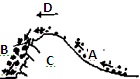
The following schematic diagram represents a glaciated terrain with four different points A, B, C and D. The state at different points shown are X-Glacial Ice movement, Y-Glacial plucking, Z-Jointed bedrock, K-Abrasion and polishing. Find the correct match .
A
A - X; B - Z; C - Y; D - K
B
A - K; B - Y; C - Z; D - X
C
A - K; B - Z; C - X; D - Y
D
A - X; B - Y; C - Z; D - K
Question 52Single Answer
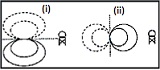
The following schematic diagram shows velocities observed by a ground Doppler radar for two atmospheric phenomena. The solid lines indicate wind component towards the radar, the dashed lines indicate wind components away from the radar, and the dotted line indicates the zero isodop. Which of the following options correctly identifies the two phenomena ?
A
(i) Tornadic mesocyclone and (ii) Cold air downburst from a thunderstorm
B
(i) Sea-breeze and (ii) Mountain-valley winds
C
(i) Occluded front and (ii) Extra-tropical cyclone
D
(i) Butterfly effect and (ii) Coriolis effect
Question 53Single Answer
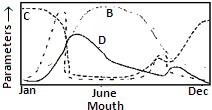
Given profiles are schematic for the surface waters in northern temperate latitudes. Identify A, B, C and D parameters .
A
A – Nutrients, B – Phytoplankton, C –Zooplankton, D – Sunlight
B
A – Sunlight, B – Phytoplankton, C – Nutrients, D – Zooplankton
C
A – Zooplankton, B – Phytoplankton, C – Chlorophyll, D – Sunlight
D
A – Sunlight, B – Phytoplankton, C – Nutrients, D – Chlorophyll
Question 54Single Answer
Find the value of f(0) if f(x+2) = (x + 1)34 – (x + 1)33 + 5 .
A
5
B
7
C
6
D
72
Question 55Single Answer
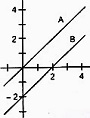
The shortest distance between the parallel lines A and B in the following figure is :
A
B
2
C
D
Question 56Single Answer
Two varieties A and B of rice cost Rs 30 and Rs 90 per kg, whereas two varieties C and D of pulases, Rs 100 and Rs 120 per kg, respectively. If at least one kg each of A and B and at least half a kg each of C and D have to be purchased, then the minimum and maximum costs of a total of 5 kg of these provisions are respectively .
A
Rs 150 and Rs 600
B
Rs 260 and Rs 530
C
RS 290 and Rs 470
D
Rs 370 and Rs 460
Question 57Single Answer
One of four suspects A, B, C and D has committed a crime. A and D are always truthful, and B and C are always untruthful. C and D are identical twins and the interrogator does not know who is who. If A says "D is innocent", B says, "A is guilty and amoung C and D one say, “A is innocent” and the other says, "B is guilty", then which of the following is FALSE ?
A
D said "A is innocent"
B
D is innocent
C
B is innocent
D
C is innocent
Question 58Single Answer
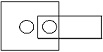
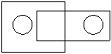
Which is an appropriate diagram to represent the relations between the following categories : quadruped, mammal, whale, house lizard ?
A
B
C
D
Question 59Single Answer
A 7 m long tube having inner diameter of 2 cm is filled with water. The water is then poured into a cylindrical bucket having inner base area of 200 cm2. What will be the approximate height (in cm) of water in the bucket ?
A
22
B
44
C
9
D
11
Question 60Single Answer
Water is being filled in a cone from the top at a constant volumetric rate. The rate of increase of the height of the water column :
A
is linearly dependent on time
B
depends on the apex angle of the cone
C
increases as cube-root of the volumetric rate
D
increases as square-root of the volumetric rate
Question 61Single Answer
A square board is divided into 9 smaller identical squares by drawing lines. Three bullets are shot at the board randomly. The probability that at least 2 bullets hit the same small square is :
A
B
C
D
Question 62Single Answer
A and B complete a work in 30 days. B and C complete the same work in 24 days wherea C and A complete the same work in 28 days. Based on these statements which of the following conclusions is correct ?
A
C is the most efficient and B is the least efficient
B
B is the most efficient but the least efficient one cannot be determined
C
C is the most efficient but, the least efficient one cannot be determined
D
C is the most efficient and A is the least efficient
Question 63Single Answer
Clock A loses 4 minutes every hour, clock B always shows the correct time and clock C gains 3 minutes every hour. On a Monday, all the three clock showed the same time, 8pm. On the following Wednesday, when the clock C shows 2 pm, what time will clock A show ?
A
7 : 20 am
B
8 : 40 am
C
9 : 20 am
D
10 : 40 am
Question 64Single Answer
In a class, there is one pencil for every two students, one eraser for every three students, and one ruler for every four students. If the total number of these stationery items required is 65 how many students are present in the class ?
A
55
B
60
C
65
D
70
Question 65Single Answer
The given table shows the numbers of active and recovered case of a certain disease. Assuming that the lienear trend for both continues, on which days will recovered cases be twice that of the active cases ?
Day
0
1
4
7
10
Active cases
990
1000
1030
1060
1090
Recovered cases
760
800
920
1040
1160
A
61
B
62
C
63
D
64
Question 66Single Answer
A boat weights 60kg, and oarsmen A and B weight 80 and 90kg, respectively. Rowing at a constant power, the time required to complete a course is proportional to the total weight. Rowing alone, A and B complete the course in 1 and 1½ hours, respectively. Assuming that their powers add up, how long will they ake to complete the course if the row together ?
A
49.4 min
B
57.5 min
C
62.6 min
D
72.5 min
Question 67Single Answer
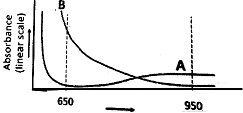
The wavelength dependant absorbance of two compounds, A and B, is shown Absorbance of mixture is a linear function of the concentration of the two compounds. R is defined as a ratio of absorbance at 650nm to the abosrbance at 950 nm . If the mixture contains 95% of compound A then R must be :
A
95
B
5
C
1
D
Less than 1
Question 68Single Answer
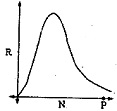
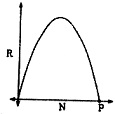
An epidemic is spreading in a population of size P. The rate of spread R of the disease at a given time is proportional to both, the number of people affected by the disease (N) and the number of people not yet affected by the disease. Which of the following graphs of R vs N is correct ?
A
B
C
D
Question 69Single Answer
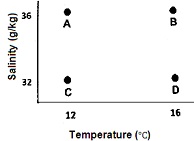
The figure shows temperature and salinity of four samples of water. Which one of the samples has the highest density ?
A
A
B
B
C
C
D
D
Question 70Single Answer
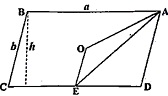
Consider a parallelogram ABCD with centre O and E as the midpoint of side CD. The area of the triangle OAE, is :
A
B
C
D
Question 71Single Answer
The sum of the first n even numbers is :
A
divisible by n and not by (n + 1)
B
divisible by (n + 1) and not by n
C
divisible by booth n and (n + 1)
D
neither divisible by n nor by (n + 1)
Question 72Single Answer
A, B, C, D and E are the vertices of a regular pentagon as shown in the figure . The angle ∠ABC is :
A
48°
B
72°
C
54°
D
36°
Question 73Single Answer
On a 200 m long straight road, maximum number of poles are fixed at 200 m interval. How many of the poles should be removed in order to have maximum number of poles at an interval of 40 m on the road ?
A
8
B
6
C
5
D
4
Question 74Single Answer
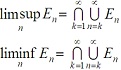
Let (En) be a squence of subsets of .
Define
Which of the following statements is true ?
A
B
(x : x ∈ En for some n)
C
= (x : x ∈ En for all but finitely many n)
D
= (x : x ∈ En for infinitely many n)
Question 75Single Answer
be a bounded function. Which of the following statements is NOT true ?
A
B
C
D
Question 76Single Answer
Which of the following statements is true ?
A
There are at most constably many continuous maps from to
B
There are at most finitely many continuous surjective maps from to
C
There are infinitely many continuous injective maps from to
D
There are no continuous bijective maps from to
Question 77Single Answer
The series converges
A
only for x = 0
B
uniformly only for x ∈ [−π, π]
C
uniformly only for x ∈ (nπ : n ∈ Z)
D
uniformly for all x ∈
Question 78Single Answer
Given (an)n≥ 1 a sequence of real numbers, which of the following statements is true :
A
B
There is a subsequence (ank)k≥1 such that converges
C
There is a b such that converges
D
There is a number b and a subsequence (ank)k≥1 such that converges
Question 79Single Answer
Given f, g are continuous function on [0,1] such that f(0) = f(1) = 0 ; = g (1) = 1 and . Which of the following statements is true ?
A
There is no t ∈ [0,1] such that f(t) = g(t)
B
There is exactly one t ∈ [0,1] such that f(t) = g(t)
C
There are atleast two t ∈ [0,1] such that f(t) = g(t)
D
There are always infinitely many t ∈ [0,1] such that f(t) = g (t)
Question 80Single Answer
Let A be an n x n matrix such that the set of all its non-zero eigenvalues has exactly r elements. Which of the following statements is true ?
A
rank A ≤ r
B
If r = 0, then rank A < n − 1
C
rank A ≥ r
D
A2 has r distinct non-zero eigenvalues
Question 81Single Answer
Let A and B be 2 x 2 metries. Then which on the following is true ?
A
det (A+B) + det(A−B) = det A + det B
B
det (A+B) + det(A−B) = 2det A − 2det B
C
det (A+B) + det(A−B) = 2det A + 2det B
D
det (A+ B) − det(A−B) = 2det A − det B
Question 82Single Answer
If A = , then A20 euqals
A
B
C
D
Question 83Single Answer
Let A be a 2 x 2 real matrix with det A = 1 and trace A = 3. What is the value of trace A2 ?
A
2
B
10
C
9
D
7
Question 84Single Answer
For a, b ∈ , let p (x, y) = a2x1y1 + abx2y1 + abx1y2+b2x2y2, x = (x1, x2) y = (y1, y2) ∈
For what values of a and b does p : x → define an inner product ?
A
a > 0, b > 0
B
ab > 0
C
a = 0, b = 0
D
For no values of a, b
Question 85Single Answer
Which of the following real quadratic froms on is positive definite ?
A
Q(X,Y) = XY
B
Q(X,Y) = X2− XY+ Y2
C
Q(X,Y) = X2− 2XY+ Y2
D
Q(X, Y) = X2 + XY
Question 86Single Answer
Let be the positively oriented circle in the complex plane given by . Then equals :
A
3
B
C
2
D
Question 87Single Answer
For a positive integer p, consider the holomorphic function
For which values of p does there exist a holomorphic function such that f(z) = g' (z) for ?
A
All even integers
B
All odd integers
C
All multiples of 3
D
All multiples of 4
Question 88Single Answer
Let be the positively oriented circle in the complex plane given by . The line integral equals :
A
B
C
D
Question 89Single Answer
Let p be a positie integer. Consider the closed curve r(t) = eit, 0 ≤ t < 2π/. Let f be a function holomorphic in {z : |z| < 2 R} where R > 1. If f has a zero only at z0, 0 < |z0| < R, and it is of multiplicity q, then equals
A
B
C
D
Question 90Single Answer
Which of the following statements is true ?
A
Every even integer n ≥ 16 divides (n – 1)! +3
B
Every odd integer n ≥ 16 divides (n – 1)!
C
Every even integer n ≥ 16 divides (n – 1)!
D
For every integer n ≥ 16, n2 divides n! + 1
Question 91Single Answer
Let X be a non-empty set and P(X) be the set of all subsets of X. On P(X) defines two operations * and Δ as follows :
for A, B P(X), A * B = A B ;
A Δ B = (A B) (A B) .
Which of the following statements is true ?
A
P(X) is a group under * as well as under Δ
B
P(X) is a group under *, but not under Δ
C
P(X) is a group under Δ, but not under *
D
P(X) is neither a group under * nor under Δ
Question 92Single Answer
Let φ(n) be the cardinality of the set {a|1 ≤ a ≤ n, (a, n ) = 1} where (a, n) denotes the gcd of a and n. Which of the following is NOT true ?
A
There exist infinitely many n such that φ(n) > φ(n+1)
B
There exist infinitely many n such that φ(n) < φ(n+1)
C
There exists N ϵ such that N > 2 and for all n > N, φ(N) < φ(n)
D
The set has finitely many limite points
Question 93Single Answer
For any two metric spaces (X, dX), (Y, dY) a map is said to be a closed map if whenever F is closed in X, then (F) is closed in Y. For any subset B of a metric space, B is given the induced metric. The metric on X x Y is given by d((x, y), (x', y')) = max {dX(x, x'), dY(y, y')}. Which of the following are true ?
A
For any subset A X in the inclusion map i : A → X is closed
B
The projection map p1 : X x Y → X given by p1 (x, y) = x is closed
C
Suppose that : X → Y, g : Y → Z are continuous maps. If g o : X → Z is a closed map then g|f(x) : (X) → Z is closed. Here g|f(x) means the map g restricted to (X)
D
If takes closed balls into closed sets then is closed
Question 94Single Answer
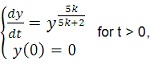
Let k be a positive integer. Consider the differential equation
Which of the following statements is true ?
A
It has a unique solution which is continuously differentiable on (0, ∞)
B
It has at most two solutions which are continuously differentiable on (0, ∞)
C
It has infinitely many solutions which are contiuously differentiable on (0, ∞)
D
It has no continuously differentiable solution on (0, ∞)
Question 95Single Answer
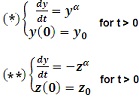
Let y0 > 0, Z0 > 0 and α > 1 .
Consider the following tow differential equations :
We say that the solution to a differential equation exists globally if it exists for all t > 0 .
which of the following statements is true ?
A
Both (*) and (**) have global solutions
B
None of (*) and (**) have global solutions
C
There exists a global solution for (*) and there exists a T < ∞ such that
D
There exists a global solution for (*) and there exists a T < ∞ such that
Question 96Single Answer
The genral solution of the surface which are perpendicular to the family of surface
z2 = kxy, k ϵ
is :
A
B
C
D
Question 97Single Answer
The general solution of the equation
A
B
C
D
Question 98Single Answer
Let be an infinitely differentiable real valued function on a bounded inerval I. Take n ≥ 1 interpolation points (x0, xi, ..., xn-1}. Take n additional interpolation points
where is such that {x0, x1, ............... x2n-1} are distinct .
Let P2n-1 be the Lagrange interpolation polynomial of degree 2n - 1 with the interpolation points (x0, x1, ....., xn-1} for the function .
Let q2n-1 be the Hermite interpolation polynomial of degree 2n - 1 with the interpolation points {x0, x1, ...., xn-1} for the function . In the limit, the quantity
A
does not necessarily converge
B
converges to
C
converges to 0
D
converges to
Question 99Single Answer
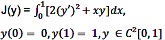
The extremal of the function
is :
A
B
C
D
Question 100Single Answer
The solution of the Fredholm integral equation
y(s) = s + 2 is :
A
y(s) = −(50s + 40s²)
B
y(s) = (30s + 15s²)
C
y(s) = −(30s + 40s²)
D
y(s) = (60s + 50s²)
Question 101Single Answer
Consider the solid S made of a material of constant density in the shape of a hemisphere of unit radius :
S = {x, y, z)|x²+y² +z² ≤ 1 z ≥ 0}
Which of the following statements is true ?
A
The centre of mass of S is at the origin
B
The x-axis is a principal axis for S
C
The moment of inertial tensor of S is not a diagonal matrix
D
The z-axis is a principal axis for S
Question 102Single Answer
In an examination involving multiple choice questions, a student works out the solution in questions the student guesses the answer. However, when the answer is guessed the probbility that is is correct is 0.30. When the student works out the solutions it may be wrong with probability 0.10 .
If the answer to a particular question is correct, what is the probability that the student guessed the answer ?
A
0.25
B
0.50
C
0.90
D
0.30
Question 103Single Answer
Let X1, X2, .......... be i.i.d. randomly variables having a x2 distribution with 5 degrees of freedom. Let a be constant.Then the limiting distribution of a is :
A
Gamma distribution for an appropriate value of a
B
X²- distribution for an appropriate value of a
C
Standard normal distribution for an appropriate value of a
D
A degenerate distribution for an appropirate value of a
Question 104Single Answer
Consider a Markov Chain X0, X1, X2, .......... with state space S. suppose i, j S are two states which communicate with each other. Whcih of the following statements is NOT correct ?
A
Period of i = period of j
B
i is recurrent if and only if j is recurrent
C
D
Question 105Single Answer
Suppose that X has uniform distribution on the interval [0, 100]. Let Y denote the greatest integer smaller than or equal to X. Which of the following is true ?
A
B
C
D
Question 106Single Answer
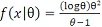
Let X1, X2, ......... Xn be i.i.d random variables with common pdf , for 0 1 is an unknown parameter. Then the statistics is :
A
sufficient, but not complete
B
sufficient, but not minimal sufficient
C
complete sufficient
D
neither complete, nor sufficient
Question 107Single Answer
Consider the pdf given by
Based on one observation X with the above pdf, a UMP test of a size α for testing H1 : θ ≤ θ0 Versus H1 : θ > θ0 is :
A
X > k for some k such that α = Pθ0 [X > k]
B
X < k for some k such that α = Pθ0 [X > k]
C
X > k for some k such that α = Pθ0 [X < k]
D
X < k for some k such that α = Pθ0 [X < k]
Question 108Single Answer
Consider 35 i.i.d. observations X1, X2, ......... X15 and Y1, Y2, .......... Y20, Let R be the Wilicoxon's rank sum statistic based on the ranks of the X's in the combined sample. Then the expected value of R is :
A
270
B
300
C
360.5
D
330.5
Question 109Single Answer
Let I, J > 5. Consider two-way ANOVA, where the observations satisfy the linear model
In this set up
A
β1 is estimable
B
y1 is estimable
C
β1 – β2 is estimable
D
β1 + g2 is estimable
Question 110Single Answer
Let X1 and X2 be two i.i.d. p x 1 multivariate normal random vectors with mean µ and positive definite dispersion matrix Σ. Then which of the following random variables always has a central chi-square distribution .
A
B
C
D
Question 111Single Answer
Consider a Randomized Block Design with b blocks and k treatment. let the observation corrresponding to the ith treatment and the jth block beyij, 1≤i ≤k, 1 ≤ j ≤ b, which satisfies the usual linear model. Which of the following is true ?
A
The estimates of any two treatment contrasts are uncorrelated
B
The error sum of squares has bk -1 degrees of freedom
C
The estimate of any treatment contrast is uncorrelated with the estimate of any block contrast
D
The correlation between the estimates of two treatment contrasts is always negative
Question 112Single Answer
The maximum and the minimum values of 5x + 7y, when |x| + |y| ≤ 1 are
A
5 and −5
B
5 and −7
C
7 and −5
D
7 and −7
Question 113Single Answer
Suppose that {fn} is a sequence of a real valued functions on . Supose it converges to a continuous function uniformly on each closed and bounded subset of . Which of the following statements are true ?
A
The sequence {fn} converges to f uniformly on
B
The sequence {fn} converges to f pointwise on
C
For all sufficiently large n, the function fn is bounded
D
For all sufficiently large n, the function fn is continuous
Question 114Single Answer
Which of the following sets are in bijection with ?
A
Set of all maps from {0,1} to
B
Set of all maps from to {0,1}
C
Set of all subsets of
D
Set of all subsets of
Question 115Single Answer
Which of the following statements are true ?
A
The series is convergent
B
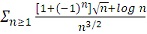
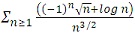
The series is absolutely convergent
C
The series is convergent
D
The series is convergent c
Question 116Single Answer
Let be defined by f(x, y) =
Define g(x, y) =
Which of the following statements are true ?
A
The function h(y) = g(c, y) is continuous on for all c
B
g is continuous from 2 into
C
g is not a well defined function
D
g is continuous on
Question 117Single Answer
where x [0, 1] which of the following statements are true ?
A
Both A(x) and B(x) converge pointwise
B
Both A(x) and B(x) converge uniformly
C
A(x) converges uniformly but B(x) does not
D
B(x) converges uniformly but A(x) does not
Question 118Single Answer
For , consider the improper integral Which of the following statements are true ?
A
B
C
D
Question 119Single Answer
Let f(x) = e−x and g(x) = e−x². Which of the following statements are true ?
A
Both f and g are uniformly continuous on
B
f is uniformly continuous on every interval of the form [a, +∞), a
C
g is uniformly continuous on
D
f(x) g(x) is uniformly continuous on
Question 120Single Answer
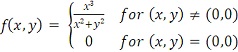
Define f
Which of the following statements are true ?
A
f is continuous at (0, 0)
B
f is continuous at (0, 0)
C
all directional derivatives of f at (0, 0) exist
D
f is not differentiable at (0, 0)
Question 121Single Answer
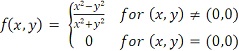
Define
A
f is continuous at (0, 0)
B
f is bounded in a neighbourhood of (0, 0)
C
f is not bounded in any neighbourhood of (0, 0)
D
f has all directional derivatives at (0, 0)
Question 122Single Answer
Let be defined by : Which of the following statements are true ?
Let P be a square matrix such that P2 = P. Which of the following statements are true ?
A
Trace of P is an irrational number
B
Trace of P = rank of P
C
Trace of P is an integer
D
Trace of p is an imaginary complex number
Question 124Single Answer
Let A and B be n x n real matrices and let .
Which of the following statement are true ?
A
If is an eigenvalue of A + B, then is an eigenvalue of C
B
If is an eigenvalue of A – B, then is an eigenvalue of C
C
If is an eigenvalue of A or B, then is an eigenvalue of C
D
All eigenvalue of C are real
Question 125Single Answer
Let A be an n x n real matrix. Let b be an n x 1 vector. Suppose Ax = b has no solution. Which of the following statements are true ?
A
There exists an n x 1 vector c such that Ax = c has a unique solution
B
There exist infinitely many vector c such that Ax = c has no solution
C
If y is the first solumn of A then Ax = y has a unique solution
D
Det A = 0
Question 126Single Answer
Let A be an n x n matrix such that the first 3 rows of A are linearly independent and the first 5 columns of A are linearly independent. Which of the following statements are true ?
A
A has atleast 5 linearly independent rows
B
3 ≤ rank A ≥ 5
C
Rank A ≥ 5
D
Rank A2 ≥ 5
Question 127Single Answer
Let n be a positive integer and F be a nonempty proper subset of {1, 2, .........., n} .
Define
Let
Which of the following statements are true ?
For
A
B
C
D
Question 128Single Answer
Let be a non-zero vector. Define a linear transformation Where x . y denotes the standard inner product in .
Which of the following statements are true ?
A
The eigenvalues of T are +1, −1
B
The determinant of T is −1
C
The trace of T is +1
D
T is distance preserving
Question 129Single Answer
A quadratic form Q(x, y, z) over represents 0 non triavially if there exists such that Q(a, b, c) = 0. Which of the following quadratic forms Q(x, y, z) over represent 0 non trivially ?
A
Q(x, y, z) = xy + z2
B
Q(x, y, z) = x2+ 3y2 −2z2
C
Q(x, y, z) = x2 − xy + y2 + z2
D
Q(x, y, z) = x2 + xy + z2
Question 130Single Answer
Let Q(x, y, z) be a real quadratic form. Which of the following statments are true ?
A
B
C
D
Question 131Single Answer
For . Which of the following are true ?
A
has finitely many zeros
B
has a sequence of zeros that converges to a removable singularity of
C
has a sequence of zeros that converges to a pole of
D
has a sequence of zeros that converges to an essential singularity of
Question 132Single Answer
Let f be a holomorphic function on the open unit disc
Which of the following are possible values of ?
A
− i
B
i
C
1
D
− 1
Question 133Single Answer
Let be a positive be the open unit disc and let be a holomorphic function. Suppose that . Which of the following are possible values of ?
A
B
C
D
Question 134Single Answer
Let n be a positive integer. For a real number R > 1, let z(θ) = Reiθ, 0 ≤ θ < 2π .
The set (θ ∈ [0, 2π) : |z(θ)n + 1| = |z(θ)n-1} contains which of the following sets ?
A
{θ ∈ [0, 2π) : cos nθ = 1}
B
{θ ∈ [0, 2π) : sin nθ = 1}
C
{θ ∈ [0, 2π) : cos nθ = -1}
D
{θ ∈ [0, 2π) : sin nθ = -1}
Question 135Single Answer
Which of the following statement are true ?
A
has countably many subgroups
B
has uncountably many subsets
C
Every finitely generate subgroup of is cyclic
D
is isomorphic to as groups
Question 136Single Answer
A
is a subgroup of
B
is not a normal subgroup of
C
has atleast two elements
D
is uncountable
Question 137Single Answer
Let G be a finite group. Which of the following are true ?
A
If has order m and if n ≥ 1 divids m, then G has a subgroup of order n
B
If for any two subgroups A and B of G, either , then G is cyclic
C
If G is cyclic, then for any two subgroups A and B of G, either
D
If for every positive integer m dividing |G|, G has a subgroup of order m, then G is abelian
Question 138Single Answer
Let R, S be commutative rings with unity, f : R → S be a surjective ring homomorphism be a non-zero prime ideal. Which of the following statements are true ?
A
f -1 (Q) is a non-zero prime ideal in R
B
f -1 (Q) is a maximal ideal in R if R is a PID
C
f -1 (Q) is a maximal ideal in R if R is a finite commutative ring with unity
D
f -1 (Q) is a maximal ideal in R if x5 = x for all X ∈ R
Question 139Single Answer
Consider the polynomial f(x) = x2 + 3x - 1. Which of the following statements are true ?
A
f is ireducible over
B
f is irreducible over
C
f is reducible over
D
is a unique factorization domain
Question 140Single Answer
Let p be an odd prime such that p = 2 (mod 3). Let be the field with p elements. Consider the subset E of given by . Which of the following are true ?
A
E has atleast two elements
B
E has atmost 2p elements
C
E can have p2 elements
D
E has atleast 2p elements
Question 141Single Answer
Consider the subset of defined as follows : Which of the following statements are true ?
A
A is connected
B
A is compact
C
A is closed
D
A is dense
Question 142Single Answer
Let X be a non-empty set. Suppose that and are two topologies over X, such that .
Which of the following statements imply that ?
A
is compact and is (Hausdorff)
B
is compact and is (Hausdorff)
C
The connected components of both and are same
D
For any subset the closure of A in is contained in the closure of A in
Question 143Single Answer
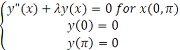
The following two-point boundary value problem has a trivial solution y = 0. It also has a non-trivial solution for :
A
no values of
B
λ = 1
C
λ = n2 for all
D
λ ≤ 0
Question 144Single Answer
Let A be an n × n matrix with distinct eigenval ues {λ1 ...,λn} with corresponding linearly in eigenvectors {v1, .., vn}. Then, the non-homogeneous differential equation x' (t) = Ax(t) + eλ1t v1
A
does not have a solution of the form eλ1t a for any vector
B
has a solution of the form eλ1t a for some vector a
C
has a solution of the form eλ1t a + teλ1t b for some vectors
D
does not have a solution of the form eλ1t a + teλ1t b for any vectors
Question 145Single Answer
Consider the solutions to the homogeneous linear system of differential equation . Which of the following statements are true ?
A
y1 and y2 form a basis for the set of all solutions to (*)
B
y1 and y2 are linearly independent but do not form a basis for the set of all solutions to (*)
C
There exists another solution y3 such that {y1, y2, y3) form a basis for the set of all solutions to (*)
D
y, and y2 are linearly dependent
Question 146Single Answer
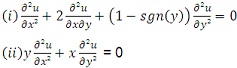
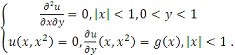
Consider the partial differential equations :
Which of the folloss statements are true ?
A
Equation (i) is parabolic for v > 0 and elliptic for y < 0
B
Equation (i) is hyperbolic for y > 0 and elliptic for y > 0
C
Equation (ii) is elliptic in I and III quadrant and hyperbolic in II and IV quadrant
D
Equation (ii) is hyperbolic in I and III quadrant and elliptic in II and IV quadrant
Question 147Single Answer
Consider the Cauch Problem
Which of the following statements are true ?
A
A necessary condition for a solution to exist is that g is an odd function
B
A necessary condition for a solution to exist is that g is an even function
C
The solution (if it exists) is given by
D
The solution (if it exists) is given by
Question 148Single Answer
Fix Consider the iteration defined by
The above iteration has two distinct fixed points and such that Which of the following statements are true ?
A
The iteration (*) is equivalent to the recurrence relation
B
The iteration (*) is equivalent to the recurrence relation
C
D
Question 149Single Answer
Consider the function defined by where β ∈ (0, ∞) is a parameter. Consider the iterations . Which of the following statements are true about the iteration ?
A
For β = 1, the sequence (xk) converges to 0 linearly with asymptotic rate of convergence log102
B
For β > 1, the sequence {xk} does not converge to 0
C
For β ∈ (0, 1), the sequence {xk} converges to 0 sublinearly
D
For β ∈ (0, 1), the sequence {xk} converges to 0 superlinearly











 .

 (x : x ∈ En for some n)
 = (x : x ∈ En for all but finitely many n)
 be a bounded function. Which of the following statements is NOT true ?
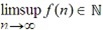


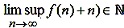
 to

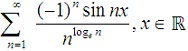 converges
 (nπ : n ∈ Z)
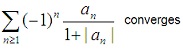
 converges
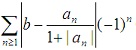 converges
 such that converges
 . Which of the following statements is true ?
 , then A20 euqals


 , let p (x, y) = a2x1y1 + abx2y1 + abx1y2+b2x2y2, x = (x1, x2) y = (y1, y2) ∈

 be the positively oriented circle in the complex plane given by
 . Then
 equals :



 such that f(z) = g' (z) for
 ?
 be the positively oriented circle in the complex plane given by
 . The line integral
 equals :


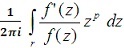 equals


 P(X), A * B = A
 B ;
 B) (A
 such that N > 2 and for all n > N, φ(N) < φ(n)
 has finitely many limite points
 is said to be a closed map if whenever F is closed in X, then
 (F) is closed in Y. For any subset B of a metric space, B is given the induced metric. The metric on X x Y is given by d((x, y), (x', y')) = max {dX(x, x'), dY(y, y')}. Which of the following are true ?
 X in the inclusion map i : A → X is closed

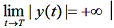





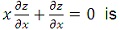
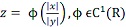

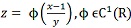

 be an infinitely differentiable real valued function on a bounded inerval I. Take n ≥ 1 interpolation points (x0, xi, ..., xn-1}. Take n additional interpolation points

 limit, the quantity




 is :
 be constant.Then the limiting distribution of a
 is :
 S are two states which communicate with each other. Whcih of the following statements is NOT correct ?




 , for 0
 is :






 . Supose it converges to a continuous function uniformly on each closed and bounded subset of
 ?

 is convergent
 is absolutely convergent
 is convergent
 is convergent c
 be defined by f(x, y) =
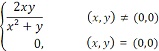
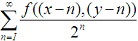
 for all c

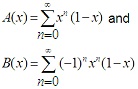
 [0, 1] which of the following statements are true ?
 , consider the improper integral
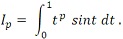






 be defined by :
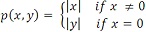
 and for all x, y
 .
 is an eigenvalue of A + B, then







 be a non-zero vector. Define a linear transformation
 Where x . y denotes the standard inner product in
 .
 represents 0 non triavially if there exists
 such that Q(a, b, c) = 0. Which of the following quadratic forms Q(x, y, z) over




 . Which of the following are true ?
 has finitely many zeros

 ?
 be a positive be the open unit disc and let
 be a holomorphic function. Suppose that
 . Which of the following are possible values of
 ?


 has countably many subgroups
 as groups
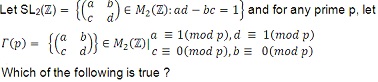
 is a subgroup of

 has order m and if n ≥ 1 divids m, then G has a subgroup of order n
 , then G is cyclic
 be a non-zero prime ideal. Which of the following statements are true ?


 be the field with p elements. Consider the subset E of
 given by
 . Which of the following are true ?
 defined as follows :

 and
 are two topologies over X, such that
 .
 ?
 is compact and
 are same
 the closure of A in


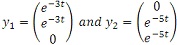 to the homogeneous linear system of differential equation
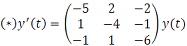 . Which of the following statements are true ?
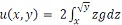
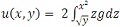
 Consider the iteration defined by

 and
 such that
 Which of the following statements are true ?




 defined by
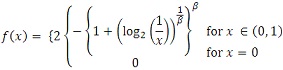
 . Which of the following statements are true about the iteration ?
 is of the form :
 , where C1 and C2 are arbitrary constants
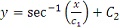 , where |c1 |<1and c2 is an arbitrary constant
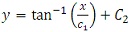 , where c1 and c2 are arbitrary constant
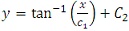 , where and c2 is an arbitrary constant