πŸ“š Exam by Category
β–Ύ
Objective Questions

Latest GATE Chemical Engineering Exam Question (Objective Questions), MCQ in English

Subjects : General Aptitude, Engineering Mathematics, Chemical Engineering

Question Bank GATE Chemical Engineering Exam (Only MCQ) - English

Back to Exam

General Aptitude

Question 1Single Answer
Inhaling the smoke from a burning _____ could _____ you quickly.
  1. A
    tire/tier
  2. B
    tire/tyre
  3. C
    tyre/tire
  4. D
    tyre/tier
Question 2Single Answer
Rice, a versatile and inexpensive source of carbohydrate, is a critical component of diet worldwide. Climate change, causing extreme weather, poses a threat to sustained availability of rice. Scientists are working on developing Green Super Rice (GSR), which is resilient under extreme weather conditions yet gives higher yields sustainably.
Which one of the following is the CORRECT logical inference based on the information given in the above passage ?
  1. A
    GSR is an alternative to regular rice, but it grows only in an extreme weather
  2. B
    GSR be used in future in response to adverse effects of climate change
  3. C
    GSR grows in an extreme weather, but the quantity of produce is lesser than regular rice
  4. D
    Regular rice will continue to provide good yields even in extreme weather
Question 3Single Answer
The cost price of 20 articles is the same as the selling price of x articles. If the profit is 25%, then the value of x is :
  1. A
    15
  2. B
    16
  3. C
    18
  4. D
    25
Question 4Single Answer
Pipes P and Q can fill a storage tank full of water in 10 and 6 minutes, respectively. Pipe R draws the water out from the storage tank at a rate of 34 litres per minute. P, Q and R operate at a constant rate. If it takes one hour to completely empty a full storage tank with all the pipes operating simultaneously, what is the capacity of the storage tank (in litres) ?Β 
  1. A
    26.8Β 
  2. B
    60.0Β 
  3. C
    120.0
  4. D
    127.5
Question 5Single Answer
Choose the grammatically correct sentence?
  1. A
    Neither of the robots are functioning properly
  2. B
    Neither robots is functioning properly
  3. C
    Neither of the robot are functioning properly
  4. D
    Neither of the robots is functioning properly

Engineering Mathematics

Question 6Single Answer
Consider the following expression :
where z, y, and t are variables, andΒ  Β is a complex number. The partial differential equation derived from the above expression is
  1. A
  2. B
  3. C
  4. D
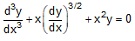
Question 7Single Answer
For the equation
the correct description is
  1. A
    an ordinary differential equation of order 3 and degree 2Β 
  2. B
    an ordinary differential equation of order 3 and degree 3Β 
  3. C
    an ordinary differential equation of order 2 and degree 3Β 
  4. D
    an ordinary differential equation of order 3 and degreeΒ 
Question 8Single Answer
The value of (1 + i)12, whereΒ  , is.
  1. A
    – 64 iΒ 
  2. B
    64 i
  3. C
    64Β 
  4. D
    – 64
Question 9Single Answer
If (A=\begin{bmatrix}1&2\3&4\end{bmatrix}), what is (\det(A))?
  1. A
    2
  2. B
    (-2)
  3. C
    5
  4. D
    10
Question 10Single Answer
If (A) is a (3\times3) matrix with (\det(A)=5), what is (\det(2A))?
  1. A
    10
  2. B
    40
  3. C
    20
  4. D
    80

Chemical Engineering

Question 11Single Answer
Which statement correctly describes a steady-state process?
  1. A
    Process variables at fixed locations do not change with time
  2. B
    Mass within the system continuously decreases
  3. C
    Mass within the system continuously increases
  4. D
    Process variables must be uniform throughout the system
Question 12Single Answer
What is the general mass-balance equation for a non-reacting system?
  1. A
    Input + Output = Accumulation
  2. B
    Input βˆ’ Output = Accumulation
  3. C
    Input βˆ’ Accumulation = Generation
  4. D
    Output βˆ’ Input = Consumption
Question 13Single Answer
For a steady-state non-reacting process, the overall mass balance reduces to which relation?
  1. A
    Input + Output = Accumulation
  2. B
    Input = Accumulation
  3. C
    Output = Accumulation
  4. D
    Input = Output
Question 14Single Answer
What is the accumulation term in a steady-state mass balance?
  1. A
    Equal to the inlet flow rate
  2. B
    Equal to the outlet flow rate
  3. C
    Equal to the generation rate
  4. D
    Equal to zero
Question 15Single Answer
Which balance is always valid for a chemical process when nuclear reactions are absent?
  1. A
    Total mass balance
  2. B
    Total mole balance
  3. C
    Total volume balance
  4. D
    Total concentration balance
Question 16Single Answer
Why may the total number of moles change during a chemical reaction?
  1. A
    Stoichiometry can change the total number of molecular species
  2. B
    Atomic masses change during reaction
  3. C
    Total mass is destroyed during reaction
  4. D
    Molecular volume must remain constant
Question 17Single Answer
A feed contains 30 kg of solute and 70 kg of solvent. What is the mass fraction of solute?
  1. A
    0.20
  2. B
    0.30
  3. C
    0.40
  4. D
    0.70
Question 18Single Answer
A solution contains 20 wt% NaCl. How much NaCl is present in 250 kg of solution?
  1. A
    40 kg
  2. B
    80 kg
  3. C
    60 kg
  4. D
    50 kg
Question 19Single Answer
A gas mixture contains 2 mol Nβ‚‚ and 8 mol Hβ‚‚. What is the mole fraction of Nβ‚‚?
  1. A
    0.20
  2. B
    0.10
  3. C
    0.25
  4. D
    0.80
Question 20Single Answer
What must the sum of all mass fractions in a mixture equal?
  1. A
    1
  2. B
    0.5
  3. C
    0
  4. D
    Molecular weight
Question 21Single Answer
What must the sum of all mole fractions in a mixture equal?
  1. A
    0.1
  2. B
    Total number of moles
  3. C
    1
  4. D
    Average molecular weight
Question 22Single Answer
What is the average molecular weight of a binary mixture containing mole fractions 0.5 of Nβ‚‚ and 0.5 of Oβ‚‚?
  1. A
    28 kg/kmol
  2. B
    30 kg/kmol
  3. C
    29 kg/kmol
  4. D
    32 kg/kmol
Question 23Single Answer
A stream contains 40 kmol/h methane and 60 kmol/h nitrogen. What is the methane mole fraction?
  1. A
    0.30
  2. B
    0.40
  3. C
    0.50
  4. D
    0.60
Question 24Single Answer
A 500 kg/h stream contains 10 wt% solids. What is the solids flow rate?
  1. A
    25 kg/h
  2. B
    50 kg/h
  3. C
    40 kg/h
  4. D
    100 kg/h
Question 25Single Answer
A 1000 kg/h feed containing 20 wt% water is dried until the product contains 10 wt% water. If dry solids are conserved, what is the product flow rate?
  1. A
    888.9 kg/h
  2. B
    800.0 kg/h
  3. C
    900.0 kg/h
  4. D
    1111.1 kg/h
Question 26Single Answer
In the previous drying problem, approximately how much water is removed?
  1. A
    88.9 kg/h
  2. B
    100.0 kg/h
  3. C
    200.0 kg/h
  4. D
    111.1 kg/h
Question 27Single Answer
A 100 kg/h solution containing 30 wt% solute is mixed with 200 kg/h solution containing 15 wt% solute. What is the solute flow rate in the mixed stream?
  1. A
    45 kg/h
  2. B
    50 kg/h
  3. C
    60 kg/h
  4. D
    75 kg/h
Question 28Single Answer
What is the solute mass fraction of the mixed stream in Question 17?
  1. A
    0.20
  2. B
    0.15
  3. C
    0.25
  4. D
    0.30
Question 29Single Answer
Which quantity is normally selected as a calculation basis in process calculations?
  1. A
    An arbitrary convenient amount or flow of material
  2. B
    The largest molecular weight in the system
  3. C
    The smallest concentration in the process
  4. D
    The atmospheric pressure of the process
Question 30Single Answer
Why is a calculation basis useful in material-balance problems?
  1. A
    It eliminates chemical reactions
  2. B
    It makes every process steady state
  3. C
    It provides a definite reference quantity for calculations
  4. D
    It eliminates unknown compositions
Question 31Single Answer
A stream is specified as 25 mol% COβ‚‚. On a basis of 100 mol, how many moles of COβ‚‚ are present?
  1. A
    20 mol
  2. B
    75 mol
  3. C
    40 mol
  4. D
    25 mol
Question 32Single Answer
A mixture contains 40 kg A and 60 kg B. What is the mass ratio A/B?
  1. A
    0.40
  2. B
    0.60
  3. C
    1.50
  4. D
    0.667
Question 33Single Answer
What is the mole fraction of B?
  1. A
    0.65
  2. B
    0.50
  3. C
    0.35
  4. D
    0.75
Question 34Single Answer
Which variable is an extensive property?
  1. A
    Temperature
  2. B
    Pressure
  3. C
    Total mass
  4. D
    Mass fraction
Question 35Single Answer
Which variable is an intensive property?
  1. A
    Total moles
  2. B
    Mole fraction
  3. C
    Mass flow rate
  4. D
    Total mass
Question 36Single Answer
A tank initially contains 100 kg liquid and receives 10 kg/min while discharging 6 kg/min. What is its mass accumulation rate?
  1. A
    2 kg/min
  2. B
    6 kg/min
  3. C
    4 kg/min
  4. D
    16 kg/min
Question 37Single Answer
How much liquid will be in the tank of Question 26 after 5 min if the flow rates remain constant?
  1. A
    120 kg
  2. B
    110 kg
  3. C
    130 kg
  4. D
    150 kg
Question 38Single Answer
A tank receives 8 kg/min and loses 12 kg/min. What is the net accumulation rate?
  1. A
    βˆ’4 kg/min
  2. B
    βˆ’2 kg/min
  3. C
    4 kg/min
  4. D
    20 kg/min
Question 39Single Answer
What characterizes an unsteady-state material balance?
  1. A
    Accumulation is necessarily zero
  2. B
    Chemical reactions cannot occur
  3. C
    Inlet and outlet rates must be identical
  4. D
    Process variables may change with time
Question 40Single Answer
Which mathematical form commonly represents accumulation in a transient tank?
  1. A
    (M/t)
  2. B
    (dM/dt)
  3. C
    (M^2/t)
  4. D
    (dt/dM)
Question 41Single Answer
A well-mixed tank contains mass M and solute mass fraction x. What is the solute mass in the tank?
  1. A
    M/x
  2. B
    Mx
  3. C
    M(1βˆ’x)
  4. D
    x/M
Question 42Single Answer
In a perfectly mixed tank, what is the composition of the outlet stream relative to the tank contents?
  1. A
    It equals the tank composition
  2. B
    It equals the feed composition
  3. C
    It is always pure solvent
  4. D
    It is always pure solute
Question 43Single Answer
A tank with constant liquid holdup receives and discharges liquid at the same mass flow rate. Which statement is correct?
  1. A
    Total mass accumulation is zero
  2. B
    Component accumulation must also be zero
  3. C
    Outlet composition cannot change
  4. D
    Feed composition must equal tank composition
Question 44Single Answer
Can a constant-volume mixing tank have a transient component balance?
  1. A
    No, because constant volume requires steady state
  2. B
    Yes, but only when chemical reaction occurs
  3. C
    No, because inlet and outlet rates are equal
  4. D
    Yes, because composition can change with time
Question 45Single Answer
Which expression represents the component balance for a non-reacting transient system?
  1. A
    Component generation = component accumulation
  2. B
    Component input + component output = component accumulation
  3. C
    Component output βˆ’ component input = zero
  4. D
    Component input βˆ’ component output = component accumulation
Question 46Single Answer
A mixer receives 50 kg/h A and 150 kg/h B with no losses. What is its outlet flow rate at steady state?
  1. A
    100 kg/h
  2. B
    150 kg/h
  3. C
    250 kg/h
  4. D
    200 kg/h
Question 47Single Answer
A splitter receives 300 kg/h and divides the stream into two branches, one carrying 120 kg/h. What is the second branch flow rate?
  1. A
    120 kg/h
  2. B
    180 kg/h
  3. C
    150 kg/h
  4. D
    420 kg/h
Question 48Single Answer
In an ideal splitter with no phase change or separation, how do branch compositions compare with the feed composition?
  1. A
    Each branch has half the feed concentration
  2. B
    Each branch has the same composition as the feed
  3. C
    The larger branch is richer in the key component
  4. D
    The smaller branch is richer in the key component
Question 49Single Answer
Which process unit is designed to combine two or more streams?
  1. A
    Splitter
  2. B
    Purge unit
  3. C
    Mixer
  4. D
    Separator
Question 50Single Answer
Which process unit divides one stream into streams of identical composition?
  1. A
    Reactor
  2. B
    Distillation column
  3. C
    Ideal splitter
  4. D
    Absorber
Important Questions Package

GATE Chemical Engineering Exam Online Question Bank Package

Buy GATE Chemical Engineering Important Questions, MCQ, question answer in Hindi & English. It will help you to score high marks in GATE Chemical Engineering question bank 2026 in Online, PDF & Print study material.

+ Free Monthly Current Affairs, GK & more PDF Download
Sr.Package NameAmount
1.GATE Chemical Engineering Exam (Only MCQ) - English
Description : 1000 Question With Answer
β‚Ή101 [β‚Ή500]
2.GATE Chemical Engineering Exam (Only MCQ) - English
Description : 2000 Question With Answer
β‚Ή151 [β‚Ή500]
3.GATE Chemical Engineering Exam (Only MCQ) - English
Description : 3000 Question With Answer
β‚Ή181 [β‚Ή500]
4.GATE Chemical Engineering Exam (Only MCQ) - English
Description : 4000 Question With Answer
β‚Ή210 [β‚Ή500]
5.GATE Chemical Engineering Exam (Only MCQ) Question Bank Book - English
Description : 1000 Question with Answer (Printed Material)
β‚Ή390 [β‚Ή650]
6.GATE Chemical Engineering Exam (Only MCQ) - English
Description : 1000 Question & Answer Download in PDF (Send by Email)
β‚Ή151 [β‚Ή550]
Back to Exam
Question for GATE Chemical Engineering 2027 - Quiz / Questions / MCQ - Toppersexam