The payment was collected by the hardworking salesman.
A
The hardworking salesman collected the payment.
B
the salesman who worked heard was able to collect the payment.
C
to collect the payment the salesman had to work hard.
D
The hardworking salesman was able to collect the payment.
Question 4Single Answer
I had to stop all my work to complete this project.
A
All other work had to be stopped to complete this project by me
B
For completing this project all other work must be stopped
C
For completing this project I had to stop all my work
D
To complete this project all other work had been stopped by me
Question 5Single Answer
They have published the names of all the successful candidates.
A
The candidates who have succeeded their names they had published.
B
The names of all the successful candidates have been published by them
C
The candidates who have succeeded their names have been published by them.
D
The names of all the successful candidate were published by them.
Question 6Single Answer
The online shopping site lowered the prices.
A
Lowering of the prices was done by the online shopping site
B
The prices were lowered by the online shopping site
C
The prices had been lowered by the online shopping site
D
The prices have been lowered by the online shopping site
Question 7Single Answer
Who taught you to drive a truck ?
A
To drive a truck by whom were you taught?
B
Driving a truck by who were you taught?
C
Driving a truck by who were you being taught?
D
By whom were you taught to drive a truck?
Question 8Single Answer
We shall invite Suresh.
A
Suresh would be invited by us
B
Suresh would have been invited by us
C
Suresh will be invited by us
D
Suresh will have been invited by us
Question 9Single Answer
Dark clouds have overcast the evening sky.
A
By the dark clouds the evening sky was overcast.
B
The evening sky has been overcast by the dark clouds.
C
Dark clouds overcastted the evening sky.
D
The sky of the evening was overcasted by dark clouds.
Question 10Single Answer
The partners will celebrate their triumph tomorrow.
A
The triumph would be celebrated by the partners a day before
B
The triumph would be celebrated by the partners a day after
C
The triumph would have been celebrated by the partners a day after
D
The triumph will have been celebrated by the partners tomorrow
Question 11Single Answer
Passage :
Direction : Question below has two blanks, each blank indicting that some thing has been omitted. Choose the word for each blank which best fits the meaning of the sentence as a whole.
The Finance Department has ……………a centralized online databank system for all statutory government bodies to …………an eye on their assets and liabilities.
A
presented , stay
B
introduced , keep
C
announce , make
D
created , let
E
proclaimed , hold
Question 12Single Answer
Passage :
Direction : The five items in this section consists of a word or group of words followed by four words as (a), (b), (c) and (d). Select the word which is nearly opposite to the meaning of the original word or group of words and mark your response as (a), (b), (c) and (d), as the case may be, in your Answer Sheet.
Assets
A
liabilities
B
responsibilities
C
estates
D
profits
Question 13Single Answer
Passage :
Direction : In the question, out of the four alternatives, choose the word which is opposite in meaning to the given word and click the button corresponding to it
Affidavit
A
Affirmation
B
Slander
C
Oath
D
Testimony
Question 14Single Answer
Passage :
Direction: In the following question, out of the four alternatives, choose the word which is opposite in meaning to the given word and click the button corresponding to it
Hollow
A
Alveolate
B
Cleft
C
Cavernous
D
Solid
Question 15Single Answer
Passage :
Directions: In the following question, out of the four alternatives, choose the word which is opposite in meaning to the given word and click the button corresponding to it
Cosset
A
Ignoreb
B
Close
C
Caress
D
Fondle
Question 16Single Answer
Passage :
Directions: In the following question, out of the four alternatives, choose the word which is opposite in meaning to the given word and click the button corresponding to it
Ogle
A
Leer
B
Gaze
C
Ignore
D
Gawk
Question 17Single Answer
Passage :
Directions:In the following question, out of the four alternatives, choose the word which is opposite in meaning to the given word and click the button corresponding to it
Intrinsic
A
Elemental
B
Innate
C
Connate
D
Acquired
Question 18Single Answer
Passage :
Direction : In the following question, out of the four alternatives, choose the word which is opposite in meaning to the given word and click the button corresponding to it
Coalesce
A
Separate
B
Adhere
C
Cleave
D
Amalgamate
Question 19Single Answer
Passage :
Directions: In the following question, out of the four alternatives, choose the word which is opposite in meaning to the given word and click the button corresponding to it
Loiter
A
lag
B
Hasten
C
Amble
D
Loii
Question 20Single Answer
Passage :
Direction : Question below has two blanks, blank indicating that something has been omitted. Choose the set of words for blank which best fits the meaning of the sentence as a whole.
The protests were......... at ......... awareness among the elite and the educated.
A
held, generating
B
aimed, creating
C
targeted, awakening
D
focused, building
E
concentrated, producing
Reasoning Ability
Question 21Single Answer
How many such pairs of letters are there in the word ‘CLEANLINESS’ each of the which has as many letters between them in the word as they have in the English alphabet, in the same sequence?
A
Two
B
Three
C
Five
D
Four
E
None of these
Question 22Single Answer
Team A has scored more goals than Team B
Team C has scored fewer goals than Team B
Team A has scored fewer goals than Team C .
If the first two statements are true, the third statement is
A
True
B
False
C
Uncertain
D
None
Question 23Single Answer
If it is possible to make only one meaningful word with the second, the third, the sixth and the eight letters of the word FRAGMENT using each only once, which of the following will be the third letter of that word ? If no such word can be formed, give ‘X’ as the answer and if more than one such word can be formed, give ‘Y’ as the answer.
A
A
B
E
C
T
D
X
E
Y
Question 24Single Answer
How many such letters are there in the word ORIENTAL each of which is as far away from the beginning of the word as when they are arranged alphabetically?
A
None
B
One
C
Two
D
Three
E
More than three
Question 25Single Answer
How many such pairs of letters in the word CREDIT each of which has as many letters between them in the word as in the English alphabet?
A
None
B
One
C
Two
D
Three
E
More than three
Question 26Single Answer
How many meaningful words can be made from the letters ‘LMEA’ using each letter only once in each word?
A
None
B
One
C
Two
D
Three
E
More than three
Question 27Single Answer
If it is possible to make only one meaningful word with the first, the second, the seventh and the eighth letters of the word TEMPORAL, which of the following will be the first letter of that word? If more than one such word can be made, give ‘Y’ as the answer and if no such word can be made, give ‘X’ as the answer.
A
T
B
L
C
E
D
Y
E
X
Question 28Single Answer
If the letters of the word HANDOVER are arranged alphabetically from left to right how many letters will remain at the same position?
A
None
B
One
C
Two
D
Three
E
More than three
Question 29Single Answer
How many such pairs of letters are there in the word EXCURSION, each of which has as many letters between them in the word as they have in the English alphabet?
A
None
B
One
C
Two
D
Three
E
More than three
Question 30Single Answer
If it is possible to make only one meaningful word with the first, the second, the third, the sixth and the eighth letters of the word DEVIATION first letter of that word is your answer? If more than one such word can be made formed your answer is ‘A’ and if no such word can be formed your answer is ‘B’.
A
V
B
T
C
E
D
A
E
B
Question 31Single Answer
Passage :
A B C D E F G H I J K L M N O P Q R S T U V W X Y Z .
Which letter in this alphabet is the eighth letter to the right of the letter and which is tenth letter to the left of the last but one letter of the alphabet ?
A
X
B
W
C
I
D
H
Question 32Single Answer
Passage :
Direction : The following question is based on the five words given below:
AND FOR THE BIG SUM (The new words formed after performing the mentioned operations may or may not necessarily the meaningful English words.)
If the third alphabet of each of the words is changed to the next alphabet in the English alphabetical series, which of the following will form a meaningful English word?
A
SUM
B
BIG
C
Both BIG and THE
D
FOR
E
Both FOR and BIG
Question 33Single Answer
Passage :
Direction : The following question is based on the five words given below:
AND FOR THE BIG SUM (The new words formed after performing the mentioned operations may or may not necessarily the meaningful English words.)
If the given words are arranged in the order as they would appear in a dictionary from left to right, which of the following will be second from the right ?
A
AND
B
FOR
C
THE
D
BIG
E
SUM
Question 34Single Answer
Passage :
Direction: The following question is based on the five words given below:
AND FOR THE BIG SUM (The new words formed after performing the mentioned operations may or may not necessarily the meaningful English words.)
If second alphabet in each of the words is changed to next alphabet in the English alphabetical order, how many words having two vowels (same or different vowels) will be formed ?
A
None
B
One
C
Two
D
Three
E
Four
Question 35Single Answer
Passage :
Direction : The following question is based on the five words given below:
AND FOR THE BIG SUM (The new words formed after performing the mentioned operations may or may not necessarily the meaningful English words.)
How many letters are there in the English alphabetical series between the second letter of the word which is second from the right and the second letter of the word which is second from the left of the given words?
A
Two
B
Five
C
Six
D
Nine
E
Three
Question 36Single Answer
Passage :
Direction: The following question is based on the five words given below:
AND FOR THE BIG SUM (The new words formed after performing the mentioned operations may or may not necessarily the meaningful English words.)
If in each of the given words, each of the consonant is changed to previous letter and each vowel is changed to next letter in the English alphabetical series, in how many words thus formed will no vowels appear?
A
None
B
One
C
Two
D
Three
E
More than three
Question 37Single Answer
Passage :
Direction : Following question is based on five words given below: BRU LEGINKCATOWN
(The new words formed after performing the mentioned operations may or may not necessarily be meaningful English words)
If the third alphabet in each of the words is changed to the next alphabet in the English alphabetical order, how many words having two vowels (same or different vowels) will be formed?
A
None
B
One
C
Two
D
Three
E
Four
Question 38Single Answer
Passage :
Direction : Following question is based on five words given below: BRU LEGINKCATOWN
(The new words formed after performing the mentioned operations may or may not necessarily be meaningful English words)
If the position of the first and the second alphabets of each of the words are interchanged, which of the following will form a meaningful English word?
A
Both CAT and OWN
B
Both BRU and INK
C
Only CAT
D
Only INK
E
Only LEG
Question 39Single Answer
Passage :
Direction: Following question is based on five words given below: BRU LEGINKCATOWN
(The new words formed after performing the mentioned operations may or may not necessarily be meaningful English words)
If the given words are arranged in the order as they would appear in a dictionary from left to right, which of the following will be exactly in the middle of the five words?
A
OWN
B
LEG
C
BRU
D
CAT
E
INK
Question 40Single Answer
Passage :
Direction: Following question is based on five words given below: BRU LEGINKCATOWN
(The new words formed after performing the mentioned operations may or may not necessarily be meaningful English words)
If in each of the given words, each of the consonants is changed to previous letter and each vowel is changed to next letter in the English alphabetical series, in how many words thus formed will the same alphabet appear twice?
A
None
B
One
C
Two
D
Three
E
More than three
Quantitative Aptitude
Question 41Single Answer
The cash difference between the selling prices of an article at a profit of 4% and 6% is Rs. 3. The ratio of the two selling prices is:__________ ?
A
51:52
B
52:53
C
51:53
D
52:55
Question 42Single Answer
Which of the following numbers is irrational ?
A
√49
B
0.125
C
√2
D
22/7
Question 43Single Answer
356 x 936 – 356 x 836 = ?
A
35600
B
34500
C
9630
D
93600
Question 44Single Answer
Arrange in descending order: 5/8, 7/10, 3/4
A
3/4 > 7/10 > 5/8
B
7/10 > 3/4 > 5/8
C
3/4 > 5/8 > 7/10
D
5/8 > 7/10 > 3/4
Question 45Single Answer
What is (3^{4} times 9^{2}) ?
A
36
B
38
C
310
D
96
Question 46Single Answer
If 34X-2 = 729, then find the value of X.
A
4
B
3
C
2
D
5
Question 47Single Answer
Convert 0.6 into fraction ?
A
3/5
B
2/3
C
4/5
Question 48Single Answer
The no. plate of a bus had peculiarity. The bus number was a perfect square. It was also a perfect square when the plate numbers were reversed. The bus company had only five hundred buses numbered from 1 to 500. What was the number ?
A
169
B
36
C
196
D
Can not say
Question 49Single Answer
If a and b are positive integers, such that ab = 125, then (a-b)a+b-4 = ?
A
16
B
25
C
28
D
30
Question 50Single Answer
If x*y = x2 + y2 – xy, then value of 9*11 is
A
93
B
103
C
60.5
D
121
Important Questions Package
Bank of Maharashtra SO Exam Online Question Bank Package
Buy Bank of Maharashtra SO Important Questions, MCQ, question answer in Hindi & English. It will help you to score high marks in Bank of Maharashtra SO question bank 2026 in Online, PDF & Print study material.
+ Free Monthly Current Affairs, GK & more PDF Download
Sr.
Package Name
Amount
1.
Bank of Maharashtra SO (Senior Manager - Risk Analytics & Risk Management) Exam - Hindi
Description : 1000 Question with Answer
₹101[₹500]
2.
Bank of Maharashtra SO (Senior Manager - Risk Analytics & Risk Management) Exam - Hindi
Description : 2000 Question with Answer
₹151[₹500]
3.
Bank of Maharashtra SO (Senior Manager - Risk Analytics & Risk Management) Exam - English
Description : 1000 Question with Answer
₹101[₹500]
4.
Bank of Maharashtra SO (Senior Manager - Risk Analytics & Risk Management) Exam - English
Description : 2000 Question with Answer
₹151[₹500]
5.
Bank of Maharashtra SO (Senior Manager - Risk Analytics & Risk Management) Exam - English
Description : 3000 Question with Answer
₹181[₹500]
6.
Bank of Maharashtra SO (Senior Manager - Risk Analytics & Risk Management) Exam - Hindi
Description : 1000 Question & Answer Download in PDF (Send by Email)
₹151[₹450]
7.
Bank of Maharashtra SO (Senior Manager - Risk Analytics & Risk Management) Exam - English
Description : 1000 Question & Answer Download in PDF (Send by Email)
₹151[₹450]
8.
Bank of Maharashtra SO (Senior Manager - Risk Analytics & Risk Management) Exam Question Bank Book - Hindi
Description : 1000 Question with Answer (Printed Material)
₹450[₹800]
9.
Bank of Maharashtra SO (Senior Manager - Risk Analytics & Risk Management) Exam Question Bank Book - English
Description : 1000 Question with Answer (Printed Material)
₹390[₹600]
Quantitative Aptitude
Question 51Single Answer
Passage :
information given below and answer the question that follow.
The result of an exam is given below. Out of 1000 students who appeared
(i) 658 failed in Physics
(ii) 166 failed in Physics and Chemistry
(iii) 372 failed in Chemistry, 434 failed in Physics and Maths
(iv) 590 failed in Maths, 126 failed in Maths & Chemistry
Find the number of people who failed in (assuming that none is passed in all subjects.
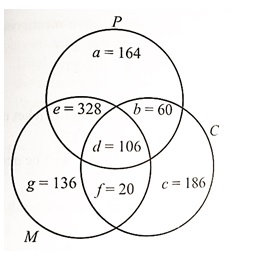
We have the following equations:
a+ b + c + d + e + f + g = 1000
a + b + d + e = 658, b + d = 166
b + d + c + f = 372
d + e = 434 as in the figure.
d + e + f + g = 590, d + f = 126. Find the values
Chemistry but not in Physics.
A
318
B
198
C
213
D
206
Question 52Single Answer
Passage :
Direction: information given below and answer the question that follow.
The result of an exam is given below. Out of 1000 students who appeared
(i) 658 failed in Physics
(ii) 166 failed in Physics and Chemistry
(iii) 372 failed in Chemistry, 434 failed in Physics and Maths
(iv) 590 failed in Maths, 126 failed in Maths & Chemistry
Find the number of people who failed in (assuming that none is passed in all subjects.
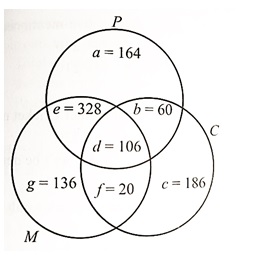
We have the following equations:
a+ b + c + d + e + f + g = 1000
a + b + d + e = 658, b + d = 166
b + d + c + f = 372
d + e = 434 as in the figure.
d + e + f + g = 590, d + f = 126. Find the values
Physics or Maths but not in Chemistry.
A
558
B
718
C
628
D
None of these
Question 53Single Answer
Passage :
For the next four question that follow:
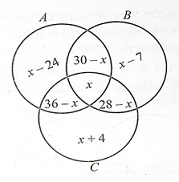
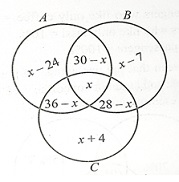
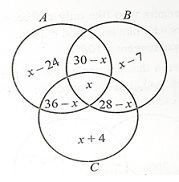
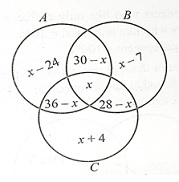
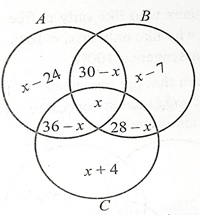
In a city, three daily newspapers A, B, C are published, 42% read A; 51% read B; 68% read C; 30% read A and B; 28% read B and C; 36% read A and C; 8% do not read any of the three newspapers.
Let x% people read all the three newspapers.
Since 8% people do not read any newspapers.
(x – 24) + (x – 7) + (x + 4) + (30 – x) + (36 – x) + (28 – x) + x = 92
→ x + 98 – 31 = 92
→ x = 92 – 67 = 25
What is the percentage of persons who read all the three papers ?
A
20%
B
25%
C
30%
D
40%
Question 54Single Answer
Passage :
For the next four : question that follow :
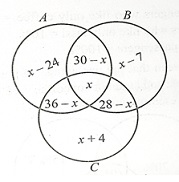
In a city, three daily newspapers A, B, C are published, 42% read A; 51% read B; 68% read C; 30% read A and B; 28% read B and C; 36% read A and C; 8% do not read any of the three newspapers.
Let x% people read all the three newspapers.
Since 8% people do not read any newspapers.
(x – 24) + (x – 7) + (x + 4) + (30 – x) + (36 – x) + (28 – x) + x = 92
→ x + 98 – 31 = 92
→ x = 92 – 67 = 25
What is the percentage of persons who read only two papers?
A
19%
B
31%
C
44%
D
None of these
Question 55Single Answer
Passage :
For the next four : question that follow :
In a city, three daily newspapers A, B, C are published, 42% read A; 51% read B; 68% read C; 30% read A and B; 28% read B and C; 36% read A and C; 8% do not read any of the three newspapers.
Let x% people read all the three newspapers.
Since 8% people do not read any newspapers.
(x – 24) + (x – 7) + (x + 4) + (30 – x) + (36 – x) + (28 – x) + x = 92
→ x + 98 – 31 = 92
→ x = 92 – 67 = 25
What is the percentage of persons who read only one paper ?
A
38%
B
48%
C
51%
D
None of these
Question 56Single Answer
Passage :
For the next four : question that follow:
In a city, three daily newspapers A, B, C are published, 42% read A; 51% read B; 68% read C; 30% read A and B; 28% read B and C; 36% read A and C; 8% do not read any of the three newspapers.
Let x% people read all the three newspapers.
Since 8% people do not read any newspapers.
(x – 24) + (x – 7) + (x + 4) + (30 – x) + (36 – x) + (28 – x) + x = 92
→ x + 98 – 31 = 92
→ x = 92 – 67 = 25
What is the percentage of persons who read only A but neither B nor C ?
A
4%
B
3%
C
1%
D
None of these
Question 57Single Answer
Passage :
For the next four : question that follow:
In a city, three daily newspapers A, B, C are published, 42% read A; 51% read B; 68% read C; 30% read A and B; 28% read B and C; 36% read A and C; 8% do not read any of the three newspapers.
Let x% people read all the three newspapers.
Since 8% people do not read any newspapers.
(x – 24) + (x – 7) + (x + 4) + (30 – x) + (36 – x) + (28 – x) + x = 92
→ x + 98 – 31 = 92
→ x = 92 – 67 = 25
If A and B are any two sets, then what is A ᴖ (A ᴗ B) equal to ?
A
Complement of A
B
Complement of B
C
B
D
A
Question 58Single Answer
Passage :
For the next four : question that follow:
In a city, three daily newspapers A, B, C are published, 42% read A; 51% read B; 68% read C; 30% read A and B; 28% read B and C; 36% read A and C; 8% do not read any of the three newspapers.
Let x% people read all the three newspapers.
Since 8% people do not read any newspapers.
(x – 24) + (x – 7) + (x + 4) + (30 – x) + (36 – x) + (28 – x) + x = 92
→ x + 98 – 31 = 92
→ x = 92 – 67 = 25
40% of the people read newspaper X, 50% read newspaper Y and 10% read both the papers. What percentage of the people read neither newspaper ?
A
10%
B
15%
C
20%
D
25%
Question 59Single Answer
Passage :
Read the passage below and solve the question based on it.
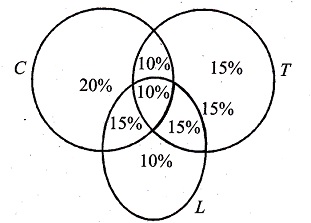
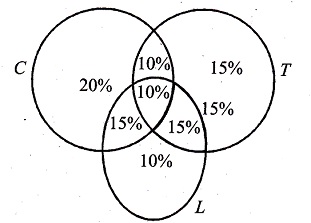
5% of the passengers do not like coffee, tea and lassi and 10% like all the three, 20% like coffee and tea, 25% like lassi and coffee and 25% like lassi and tea. 55% like coffee, 50% like tea, and 50% like lassi.
Where C = Coffee, T = Tea and L =Lassi
The passengers who like only coffee is greater than the passengers who like only lassi by
A
25%
B
100%
C
75%
D
0%
Question 60Single Answer
Passage :
Read the passage below and solve the question based on it.
5% of the passengers do not like coffee, tea and lassi and 10% like all the three, 20% like coffee and tea, 25% like lassi and coffee and 25% like lassi and tea. 55% like coffee, 50% like tea, and 50% like lassi.
Where C = Coffee, T = Tea and L =Lassi
The percentage of passengers who like both tea and lassi but not coffee, is
A
15
B
25
C
40
D
75
Professional Knowledge
Question 61Single Answer
What is the primary purpose of risk identification in risk management?
A
To reduce the risk exposure
B
To detect fraud
C
To recognize potential risks
D
To allocate resources
Question 62Single Answer
Which of the following is a key step in risk identification?
A
Risk appetite evaluation
B
Creation of risk mitigation strategies
C
Identifying all possible risks and threats
D
Conducting quantitative assessments
Question 63Single Answer
Risk identification should be a continuous process because:
A
The business environment is always changing
B
Regulatory changes never occur
C
Risk assessments are only done once a year
D
The company’s portfolio is static
Question 64Single Answer
What does qualitative risk assessment primarily focus on?
A
Numbers and statistics
B
The probability of risks
C
The nature of risks and their potential impacts
D
Identifying risk owners
Question 65Single Answer
Which of the following is an example of a quantitative risk assessment method?
A
Risk matrices
B
Scenario analysis
C
Monte Carlo simulations
D
Expert judgment
Question 66Single Answer
Which method is used in qualitative risk assessment to prioritize risks?
A
Risk scoring
B
Sensitivity analysis
C
Root cause analysis
D
Variance analysis
Question 67Single Answer
Quantitative risk assessments typically involve which of the following?
A
Estimating the impact of risk events
B
Calculating risk exposure in monetary terms
C
Determining risk tolerance
D
Identifying all potential risks
Question 68Single Answer
What is the most appropriate response to a risk that cannot be avoided?
A
Mitigate
B
Accept
C
Transfer
D
Eliminate
Question 69Single Answer
Which of the following is an example of transferring risk?
A
Purchasing insurance
B
Changing business strategy
C
Implementing controls
D
Monitoring risks regularly
Question 70Single Answer
Risk acceptance is appropriate when:
A
The risk is not material or significant
B
The risk has high probability and low impact
C
The cost of mitigation is too high
D
All of the above
Question 71Single Answer
Which of the following is the most common method for mitigating risks?
A
Outsourcing
B
Developing contingency plans
C
Ignoring the risk
D
Transferring the risk
Question 72Single Answer
Which risk response strategy is generally used when risks can be fully controlled or avoided?
A
Accept
B
Avoid
C
Transfer
D
Mitigate
Question 73Single Answer
Continuous risk monitoring helps organizations to:
A
Eliminate risks
B
Identify emerging risks early
C
Minimize the resources needed for risk management
D
Avoid changes in the risk appetite
Question 74Single Answer
Risk monitoring and reporting should be conducted:
A
After a risk has occurred
B
Periodically and continuously
C
Only during quarterly reviews
D
Only when a new project is started
Question 75Single Answer
What is the role of risk monitoring in enterprise risk management?
A
It ensures compliance with regulations
B
It tracks the effectiveness of risk responses
C
It evaluates the financial impact of risks
D
It transfers risk to external entities
Question 76Single Answer
What is meant by ‘risk appetite’?
A
The maximum amount of risk an organization is willing to bear
B
The number of risks the organization can identify
C
The total financial loss the organization can withstand
D
The cost of mitigating risks
Question 77Single Answer
Risk tolerance refers to:
A
The maximum risk the organization can take on without financial harm
B
The risk exposure that an organization is willing to accept
C
The operational limits on business activities
D
The external market forces influencing risk behavior
Question 78Single Answer
How do risk limits differ from risk tolerance?
A
Risk limits are broader than risk tolerance
B
Risk limits set the maximum acceptable amount of risk in specific areas
C
Risk limits are applied only to financial risks
D
Risk limits are irrelevant to overall risk management
Question 79Single Answer
An example of risk limits in a financial institution would be:
A
A cap on the amount of loan defaults tolerated
B
The total number of employees allowed in a department
C
A set limit on administrative costs
D
Both a and b
Question 80Single Answer
Which of the following describes risk appetite?
A
It’s a company’s willingness to pursue opportunities even when risks are present.
B
It’s a strict limit on the financial risk the company can accept.
C
It’s an emergency protocol for managing risks.
D
It’s a method of allocating resources for risk management.
Question 81Single Answer
Which of the following frameworks is widely used for Enterprise Risk Management (ERM)?
A
COSO ERM
B
SWOT analysis
C
Lean management
D
Six Sigma
Question 82Single Answer
COSO ERM framework is designed to:
A
Identify, assess, manage, and monitor risk across an organization
B
Only focus on financial risks
C
Create external marketing strategies
D
Simplify the decision-making process in the boardroom
Question 83Single Answer
One of the main components of the COSO ERM framework is:
A
Risk identification and assessment
B
Marketing strategies
C
Financial reporting
D
Budget allocation
Question 84Single Answer
The ERM process should align with which organizational goal?
A
Maximizing profit without considering risks
B
Effective use of resources and achieving strategic objectives
C
Minimizing the number of employees
D
Focusing solely on operational risks
Question 85Single Answer
Which of the following is NOT a key principle of risk management under ERM?
A
Risk management should be integrated into decision-making
B
Risk should be managed at the enterprise level
C
Risks should be avoided at all costs
D
Risk management should create value
Question 86Single Answer
What is the key purpose of risk monitoring in risk management?
A
To eliminate all risks
B
To ensure that the risk management process is functioning effectively
C
To create new risks
D
To prevent the identification of new risks
Question 87Single Answer
Which of the following methods can be used for effective risk monitoring?
A
Regular internal audits
B
Financial reporting systems
C
Stress testing and scenario analysis
D
All of the above
Question 88Single Answer
Risk reporting involves:
A
Communicating the status of risks to stakeholders
B
Risk mitigation only
C
Predicting future risks
D
Financial budget planning
Question 89Single Answer
Which of the following can be an outcome of effective risk monitoring?
A
Early detection of emerging risks
B
Improved strategic decision-making
C
Enhanced stakeholder trust
D
All of the above
Question 90Single Answer
Which of the following is a key characteristic of a good risk management reporting system?
A
Transparency in how risks are identified and managed
B
Complexity in terms of risk descriptions
C
Regular updates without stakeholder involvement
D
It avoids discussing risks in public reports
Question 91Single Answer
Which of the following defines risk tolerance in an organization?
A
The amount of risk the organization is willing to accept in pursuit of its objectives
B
The financial threshold beyond which risks cannot be accepted
C
The maximum level of loss a company can bear
D
The risk response strategies used to handle external risks
Question 92Single Answer
Which of the following is a key factor in determining risk appetite?
A
The organization's strategic goals
B
The financial assets of the company
C
The risk management budget
D
The company’s competition
Question 93Single Answer
In a situation where an organization exceeds its risk appetite, what should be done?
A
Increase the risk limits to accept more risks
B
Implement corrective actions to mitigate or avoid the excess risks
C
Transfer the risk to other organizations
D
Ignore the risk and proceed with the activity
Question 94Single Answer
Risk limits are typically set by:
A
The board of directors and senior management
B
External auditors
C
Regulators
D
Risk management staff only
Question 95Single Answer
The primary purpose of defining risk appetite and tolerance is to:
A
Establish rules for risk mitigation
B
Provide a clear understanding of the level of risk the organization can bear while achieving its objectives
C
Ensure complete elimination of all risks
D
Measure the performance of the organization
Question 96Single Answer
Which of the following best describes the role of risk governance in an ERM framework?
A
Ensuring that risk management is integrated into the organization's culture and decision-making processes
B
Managing the financial risks alone
C
Creating detailed financial reports
D
Excluding external stakeholders from the risk management process
Question 97Single Answer
Enterprise Risk Management (ERM) focuses on managing risk at which level?
A
Departmental level
B
Organizational level
C
National level
D
Regional level
Question 98Single Answer
Under the COSO ERM framework, which of the following is NOT a key component?
A
Internal control
B
Strategic risk management
C
Financial reporting
D
Continuous learning
Question 99Single Answer
Which of the following COSO ERM components focuses on identifying, analyzing, and evaluating risks?
A
Risk governance
B
Risk assessment
C
Control activities
D
Risk response
Question 100Single Answer
Enterprise Risk Management (ERM) involves evaluating risks that could affect:
A
Only the financial stability of the organization
B
The organization’s ability to achieve its objectives
C
Only operational efficiency
D
Only external market risks
Question 101Single Answer
Which of the following is a key element of effective risk reporting?
A
Regular updates and feedback on risk management performance
B
Delaying risk reporting to avoid panic
C
Excluding high-impact risks from reports
D
Focusing only on the past risks, not future ones
Question 102Single Answer
Which of the following is an example of a risk monitoring tool?
A
Business impact analysis
B
Balanced scorecard
C
Risk dashboard
D
Organizational chart
Question 103Single Answer
A risk monitoring process should focus on:
A
Identifying new risks and assessing their impact
B
Reducing the cost of risk management
C
Only controlling external risks
D
Ignoring the feedback of stakeholders
Question 104Single Answer
What is the benefit of effective risk monitoring?
A
Reducing all risks to zero
B
Ensuring that risk responses are adjusted as needed based on new information
C
Preventing any risks from occurring
D
Reporting risk responses only to senior management
Question 105Single Answer
Which of the following actions should be taken if a significant new risk is identified during monitoring?
A
Delay the response until more data is available
B
Assess the risk, update the risk management strategy, and implement necessary controls
C
Ignore the risk and proceed as usual
D
Discontinue the project or activity
Question 106Single Answer
What is the purpose of risk response strategies?
A
To eliminate all potential risks
B
To manage and mitigate identified risks
C
To focus on external business growth
D
To avoid all business risks
Question 107Single Answer
Which of the following is a key element of effective risk mitigation?
A
Ignoring the probability of risk occurrence
B
Implementing measures to reduce the severity of risks
C
Transferring all risks to third parties
D
Accepting all risks as part of the business model
Question 108Single Answer
The process of avoiding risks typically involves:
A
Ignoring the risk until it materializes
B
Altering business strategies to eliminate or reduce exposure
C
Transferring risks to other parties
D
Accepting risks that may lead to financial loss
Question 109Single Answer
When should an organization review its risk appetite?
A
Once every 5 years
B
During times of market volatility or strategic changes
C
Only when regulatory authorities require it
D
At the end of every fiscal year
Question 110Single Answer
What should an organization do if it exceeds its risk appetite?
A
Increase the risk appetite limits
B
Revise the risk management plan and implement controls to reduce exposure
C
Accept the additional risk without change
D
Withdraw from the market immediately
Question 111Single Answer
Which of the following best defines Credit Risk?
A
The risk of loss due to an organization’s failure to meet financial obligations
B
The risk of loss due to market fluctuations
C
The risk of loss due to a failure in operations
D
The risk associated with financial liquidity issues
Question 112Single Answer
Market Risk is associated with which of the following?
A
Risk of loss due to fluctuations in the stock market and interest rates
B
Risk of operational failure in a business process
C
Risk due to credit default by clients
D
Risk due to regulatory penalties
Question 113Single Answer
What does Operational Risk refer to?
A
Risk arising from external events affecting market prices
B
Risk arising from failures in internal processes, systems, or human error
C
Risk arising from poor credit assessments
D
Risk associated with liquidity shortage
Question 114Single Answer
Liquidity Risk is defined as the risk of:
A
Not being able to meet short-term financial obligations due to insufficient cash flow
B
Losing money due to credit default by a borrower
C
A company’s inability to assess the market risk
D
Risk arising from external regulations
Question 115Single Answer
Which of the following is a key characteristic of Regulatory/Compliance Risk?
A
Risk of non-compliance with government laws and regulations
B
Risk of loss from insufficient market share
C
Risk arising from operational inefficiencies
D
Risk related to financial investments
Question 116Single Answer
Strategic Risk arises from:
A
Poor business decisions and the inability to execute strategies effectively
B
Violations of market regulations
C
Inaccurate credit assessments
D
Lack of operational controls
Question 117Single Answer
Reputational Risk refers to:
A
Risk of losing market share due to negative public perception
B
Risk of failure in financial planning
C
Risk of market price fluctuation
D
Risk of operational inefficiency
Question 118Single Answer
Cyber Risk refers to:
A
Risk arising from technological failures in market transactions
B
Risk associated with data breaches and cyberattacks
C
Risk related to internal human resource management
D
Risk arising from global economic downturns
Question 119Single Answer
Which of the following is NOT considered a financial risk?
A
Credit Risk
B
Liquidity Risk
C
Market Risk
D
Reputational Risk
Question 120Single Answer
What distinguishes Strategic Risk from other types of risk?
A
It is caused by internal operational failure
B
It results from the company’s failure to align strategies with market demands
C
It is related to cyber threats and data breaches
D
It is due to liquidity crises and inability to meet financial obligations
Question 121Single Answer
Which of the following best describes the interconnectedness of risks?
A
Risks exist independently and are not related to one another
B
Risks can influence each other, with one risk triggering others
C
Only market risks are interconnected with other risks
D
Only operational risks have an impact on other types of risks
Question 122Single Answer
Credit Risk can lead to Market Risk because:
A
Credit defaults can negatively impact a company’s stock price
B
Market fluctuations can increase credit defaults
C
Financial crises in the market cause operational disruptions
D
A liquidity shortage creates operational failures
Question 123Single Answer
Operational Risk may increase Market Risk by:
A
Causing sudden price fluctuations in the market
B
Disrupting business activities, leading to stock price declines
C
Increasing the likelihood of liquidity crises
D
Reducing the ability to comply with regulations
Question 124Single Answer
Which of the following is an example of how Regulatory/Compliance Risk can trigger Strategic Risk?
A
Non-compliance with a new regulation affecting the company’s strategic goals
B
Increased liquidity risks from non-compliance with capital requirements
C
Non-compliance causing operational disruptions
D
Regulatory failures causing credit defaults
Question 125Single Answer
Cyber Risk can lead to Reputational Risk when:
A
A company fails to mitigate financial risk effectively
B
A company experiences a data breach, damaging its public image
C
Operational risks create liquidity problems for a company
D
A regulatory violation leads to public backlash
Question 126Single Answer
Reputational Risk could increase Credit Risk because:
A
A damaged reputation may cause customers to default on their loans
B
Market fluctuations lead to higher credit defaults